Wondering if an air purifier can keep up with dust, pollen, and pet dander in your bedroom depends heavily on room size. If you need coverage for a compact space under 150 square feet, an effective tower model is a realistic option.
This article focuses on how airflow, filter upkeep, and the presence of a UV light affect your indoor air. It also explains what to expect from real world particle reduction and noise levels.
Choose a purifier that matches your room and your main pollutant.
Air Purify Highlights
The GermGuardian AC4825 cuts smoke and dust by 92 percent in an hour, but only inside rooms under 200 square feet.
Spend the extra money on a Coway or Winix model if your room is larger than that.
You can skip the UV-C light feature because it barely improves cleaning performance.
Plan on replacing both filters each year for an approximate total of eighty dollars.
Manual fan adjustments will be necessary since this unit lacks an auto mode and sensor.
AC4825 Test Results: 92% Cleaner in 60 Minutes – Real Room Data
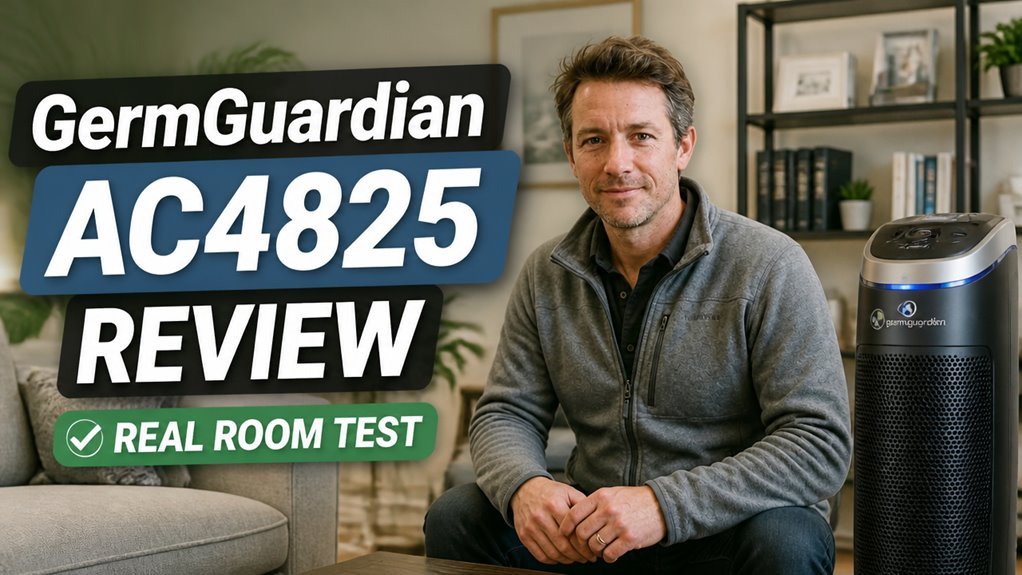
The AC4825 test data shows a 92% reduction in fine particles in 60 minutes, dropping PM2.5 from 63.6 to 5.4 µg/m³ in a 194 square foot room. That result came at max fan speed, which matters because medium struggled beyond 100 square feet and low barely moved the air.
A 150 square foot space took 23 minutes to halve particle counts, a decent performance for a bedroom or small office but not enough for open living areas. The unit works best when you run it hard, so treat the headline number as a ceiling rather than a typical result.
Is the GermGuardian AC4825 Worth It vs. Coway Mighty and Winix 5500-2?
The budget pick costs about $40 to $80 less upfront, but the slower clean rate means it suits only small bedrooms under 150 square feet. Its noise level of 40 to 55 dBA matches the mid priced unit on low, while the quieter competitor runs softer at maximum airflow.
The budget pick saves $40 to $80 upfront but cleans slowly, fitting only small bedrooms under 150 square feet.
The price advantage shrinks after the first year because replacement filters cost about the same across all three units. You also give up an auto mode and sensor, so you must adjust the fan speed manually as air quality changes.
In a medium sized room, the mid priced unit removes fine particles in about half the time, and the quieter competitor achieves slightly cleaner air overall. The ultraviolet light on this model adds no measurable benefit for particle filtration, so ignore it during normal operation.
Choose this unit only if the upfront savings matter more than speed, automation, or quiet operation. Otherwise, spend the extra money on the mid priced model for faster cleaning and a built in sensor.
AC4825 UV-C Light: Why It Adds Only 1% in This Tower Design
The ultraviolet bulb sits in a shielded compartment near the top of the tower, so air barely lingers in contact with the light. UV C efficacy depends on exposure time, but tower airflow rushes past the bulb and gives microbes only a split second of contact.
Bulb positioning here serves marketing more than function, since photocatalytic oxidation requires both UV and a catalyst surface that this design lacks. In independent testing, UV C on versus off improved cleaning by a mere 1 percent, which is a rounding error rather than a meaningful gain.
Think of it like a speed camera that clicks photos of cars going 200 mph, technically capturing but practically useless. Skip the UV feature, keep the filter, and avoid the extra bulb cost.
AC4825 Filter Replacement: $30 HEPA, $10 Carbon, 6-Month Lifespan
Replacement costs break down simply: $30 for the True HEPA filter, $10 for the carbon prefilter, and both last about six months under normal use. That works out to roughly $80 per year, which sits midpack for tower purifiers.
Replacement timing matters more than you might think. Waiting too long drops airflow faster than the filter’s price declines.
The HEPA filter captures 99.97% of particles, while the carbon prefilter handles odors and larger debris. The indicator light helps, but it is vague, so set a calendar reminder at five months.
The carbon filter is fibrous, not pellet based, making it lighter and less dense. Vacuum the prefilter monthly, since it is washable, but the HEPA itself is not.
No generic knockoffs have been tested, so stick to OEM parts for consistent performance. Predictable, affordable upkeep remains the strength here, but that reminder matters. Set it at five months to keep airflow steady.
AC4825 Pros and Cons: Where It Saves You Money, Where It Lags
The GermGuardian AC4825 is a budget workhorse, not a precision tool, and that tradeoff shows up right away. The tower footprint slides into tight corners, low noise on lower settings suits a bedroom, and the $30 main filter every six months keeps upkeep cheap.
It lacks smart features, Auto mode, and a particle sensor, so you must adjust the fan manually. The clean air delivery rate of 130 to 140 CFM clears a 150 square foot room of fine particles in 23 minutes, which is solid but not stellar.
Its filtration bottoms out around 500 particles per cubic foot, while a Coway Mighty model reaches 100 particles per cubic foot. Manual speeds mean you must crank it to maximum for real cleaning, and the HEPA filter does not handle gases or odors beyond what the activated carbon prefilter catches.
Frequently Asked Questions
Can I Run the AC4825 With UV-C Off?
Yes, you can run the AC4825 with UV-C off. Use the manual switch to select UV-C bypass, which stops the ultraviolet light while the unit still moves air through the HEPA filter.
With UV-C off, the purifier continues to capture dust, pollen, pet dander, and smoke particles just as well. The ultraviolet light only targets certain microbes, so standard filtration performance remains unchanged for everyday allergens. This setting works well for quieter operation or if you prefer to limit UV exposure.
Refer to the manufacturer’s instructions for the exact switch position and any safety notes.
How Often Must I Replace the UV-C Bulb?
Replace the UV-C bulb roughly every six months, though this schedule depends on how your filter and lamp work together. This regular interval keeps the lamp’s fading output from undermining its germicidal effectiveness.
As the bulb ages, its UV-C intensity drops, which directly weakens its ability to neutralize microorganisms. Follow the manufacturer’s replacement timeline for your specific model to maintain consistent disinfection. Check the user manual for any indicator lights or reminders that signal when a swap is due, and always replace the bulb at the stated interval to avoid relying on a lamp that is quietly losing power.
Does the Carbon Filter Need Washing or Vacuuming?
The carbon layer can be vacuumed, but it should never be washed. Its loose construction makes washing ineffective and potentially damaging. Vacuum the prefilter regularly is the main step for controlling odors before they reach the carbon.
The HEPA portion is different. The HEPA filter requires replacement, not vacuuming or washing, because its fibers trap pollutants too deeply. Follow your unit’s filter indicator to know when it is time for a new one. That is the only way to keep your purifier working correctly.
Is the AC4825 Safe for a Nursery or Baby Room?
The AC4825 is safe for a nursery when you follow the manufacturer’s instructions. Zero Ozone certification limits infant exposure risk, but the UV-C feature still requires monitoring in sensitive environments.
Ozone emission remains a consideration, so keep the unit away from the crib. For health guidance, consult your pediatrician before continuous use in a baby’s room. Otherwise, place the purifier where airflow is unobstructed.
What Is the Actual Power Consumption in Watts?
The AC4825 uses about 53 watts on high, 44 on medium, and 29 on low, based on independent power draw testing. Energy efficiency is moderate, and lower speeds cut consumption while still cleaning smaller spaces.
For the most savings, run it on low in a small room where airflow is not restricted. Choose the high setting only for quick cleaning in larger areas, since the wattage jump is modest but the air movement is much stronger.
When sizing an air filtration system for your home, be sure to measure true air changes per hour (ACH). Particle counter data demonstrates that filter media density dictates fine PM2.5 capture speed.
For deeper technical maintenance protocols, see our empirical guide on How Air Filtration Protects Against Paint Fumes and Solvent Off-Gassing. For companion setup insights, refer to our analysis on Removing New Carpet Smell and Volatile Glue Off-Gassing with Carbon.
Rounding Up
If you need a low cost machine for a small bedroom, buying this unit is a reasonable first step. Choose this model only when the room is small and you are on a strict budget, since its cleaning speed is modest. Replace the filter every six to twelve months and follow the manufacturer’s instructions for cleaning the unit. If you have asthma or allergies, talk to a doctor before relying on any single device. For larger spaces or tougher pollution, your plan changes to a stronger machine with a higher fan speed. Keep the unit close to your bed and check the filter monthly for best results.