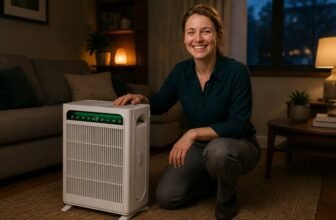
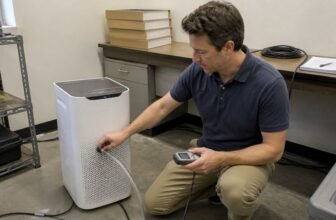
If sawdust from heavy woodworking is your main concern, you need more than the standard four air changes per hour. Aim for five air changes per hour, which means a typical two car garage needs roughly 453 CFM of real airflow.
Choose a unit rated at 500 to 700 CFM, since actual airflow runs about 30 percent lower than the rating. A MERV 12 filter captures sawdust well without choking airflow, so skip the HEPA option.
Mount the unit high and angle it from a corner to improve circulation. This article explains the sizing math and placement details, so you can confidently pick a purifier that matches your garage and your dust load.
Air Purify Highlights
- Aim for eight air changes per hour in a heavy sawdust shop, since five only handles the visible haze.
- Calculate the CFM you need by multiplying the room’s length, width, and height by eight, then dividing by sixty.
- Pick a unit rated for 500 to 700 CFM in a two car garage, because bigger fans add noise without cleaning better.
- Expect a dirty prefilter to cut real airflow by thirty percent, so choose a fan with strong motor draw.
- Mount the cleaner high in a corner, angled toward the center, and leave 18 to 24 inches of clearance on the intake side.
Why 5 ACH Is the Real Baseline for a Garage Air Cleaner

The 5 ACH baseline is the garage air turnover floor for heavy sawdust, meaning the entire room’s air passes through a cleaner five times hourly. That is enough to catch visible dust mid-session without chasing obsessive hyper cleanliness.
At 5 ACH, a typical two car garage of 680 square feet with an 8 foot ceiling needs roughly 453 CFM of airflow. That real airflow figure contrasts with manufacturer ratings, since a 754 CFM unit often delivers 30% less once the filter loads up.
Start here rather than at 4 ACH, because five keeps the haze manageable without turning the shop into a wind tunnel. Match your room volume to 5 ACH, or the cleaner becomes decoration rather than a working tool.
Calculate CFM for Your Exact Garage Size (Simple Formula)
Calculate the airflow you need with one formula: CFM equals length times width times height times air changes per hour, divided by 60. For heavy sawdust, target 8 air changes per hour, meaning the whole room’s air gets scrubbed eight times hourly.
Measure your garage, say 20 by 20 feet with a 9 foot ceiling, giving you 3,600 cubic feet of room volume. Multiply that by 8, divide by 60, and you get 480 CFM.
Check the unit’s motor draw, not just its rated clean air delivery rate or advertised airflow. A weak motor will not move that air even if the label looks impressive.
For a 2 car garage, a 500 to 700 CFM rated unit works fine for sawdust control. Larger units mostly add noise, not better air changes per hour.
Size the airflow to your measured space, and you avoid overspending on power consumption and filter replacement needs. A correctly sized unit keeps fine particles in check without excessive sound levels.
Why Your 725 CFM Unit Only Delivers 500 CFM in Practice
The gap between a rated 725 CFM and a real 500 CFM comes from the difference between lab testing and actual room conditions. Fan curve testing measures airflow with no resistance, while your ductwork, filters, and motor all add resistance that slows the air.
Each 90 degree elbow in your ducting chokes flow and can cut roughly 10 percent of the CFM. A dirty prefilter builds up quickly and can slash output by a third within a few weeks.
Static pressure losses spike as pleats in the filter clog, forcing the motor to strain against denser air. At higher elevations, thinner air reduces the mass moved per minute even if the volume reading stays similar.
Heat from continuous operation causes motor sag, which drops the RPMs and shifts the fan curve downward. To estimate real airflow, factor in your duct length, filter age, and elevation rather than trusting the box rating alone.
Skip HEPA: Why MERV 12 Is the Better Workshop Filter
MERV 12 filters are the better choice for most workshops because they capture sawdust and fine particles down to 1 micron at a fraction of the cost of HEPA. HEPA’s 99.97 percent efficiency at 0.3 microns exceeds what woodworking air quality actually requires, since sawdust mostly settles at 10 microns or larger.
Filter flammability also favors MERV 12, as its less dense media allows better airflow and reduces motor strain in a dust rich environment. MERV 12 filters run cooler and cost less than HEPA, which restricts airflow more and increases fire risk.
- MERV 12 filters cost less per unit and impose a lower fan load on your air purifier.
- HEPA filters cost more and raise power consumption due to denser media.
For the vast majority of woodworking tasks, MERV 12 delivers the needed particle removal without the extra cost or airflow penalty. HEPA remains appropriate for cleanrooms, not sawdust filled shops, where the heavy chips and fine dust are already handled by MERV 12.
Where to Mount Your Air Cleaner (It’s Not a Dust Collector)
Mount the air cleaner high, near the ceiling, because it recirculates air rather than collecting dust from a ducted system. This placement captures rising fine particles before they settle onto surfaces.
Position the unit in a corner, angled toward the room’s center, so it draws air from two directions at once. Leave 18 to 24 inches of open space on the intake side to ensure adequate return airflow.
Use vibration isolation mounts, such as rubber washers, to reduce the hum that transfers through walls and floors. Avoid placing the unit near your dust collector’s exhaust, or you will recirculate the fine particles it emits.
Choose a mounting height that keeps the airflow path sweeping across the room’s long axis rather than pushing against a wall. For a typical two‑car garage, a unit with a clean air delivery rate around 400 to 450 CFM mounted at 7 feet provides useful coverage.
Check the filter frequently, as a loaded prefilter reduces airflow and increases noise. Replace the prefilter and the HEPA filter according to the manufacturer’s schedule to maintain performance.
Frequently Asked Questions
How Often Should I Run the Air Cleaner After a Session?
Running the air cleaner for 30 to 60 minutes after a session removes lingering fine dust. The exact runtime depends on your room volume and how heavy the work was, so adjust upward for longer or dirtier projects.
Check the filter and prefilter after each extended session, because dust accumulation reduces efficiency quickly. If the filter indicator lights up or airflow drops, clean the washable prefilter or replace the filter as the manual directs.
Can One Air Cleaner Serve Multiple Rooms in a Garage?
A single air cleaner can serve multiple garage rooms, but only if you use ducted filtration or move the unit between spaces. Without either method, airflow simply will not reach every area effectively.
Heavy sawdust demands dedicated sizing for each separate workspace. A single portable unit usually cannot achieve the necessary air changes across distinct rooms, so position the cleaner near active tasks and consider one unit per area.
What Happens if My Garage Has a Sloped Ceiling?
For a sloped ceiling, measure the room’s height at both the lowest and highest points, then average the two for volume. This average matters because it gives you the true space your air purifier must clean. Airflow near a sloped ceiling can stratify, so warm, contaminated air may linger up high. Reposition a ceiling mounted unit closer to the work zone to improve mixing and capture heavier sawdust. For best results, place the purifier lower, where dust is generated, and let its fan run continuously to break up stagnant layers.
Do I Need to Wear a Mask if the Cleaner Is Running?
Yes, a mask remains necessary even while the cleaner runs. Air cleaners lack the clean air delivery rate needed for immediate capture, so they cannot protect you in the moments before polluted air reaches the unit.
Mask filtration ratings guard against the fine particles the unit may recycle, and detached observation confirms the mask serves as a supplement, not a replacement for respiratory protection. Keep the mask on until the space has had time to clear.
Will the Air Cleaner Disturb My Dust Collection System?
An air cleaner will rarely disturb a dust collection system, unless its airflow turbulence redirects captured debris back into the room. Filter crossover becomes negligible when you do not place the unit directly in the collector’s exhaust path.
Positioning the air cleaner away from the exhaust outlet prevents any catastrophic interference. Simultaneous high speed operation could momentarily overload your circuits, so run them on separate breakers or stagger their start times for safety.
Rounding Up
Start with a high airflow unit, around 1,500 CFM, and run it continuously on high for heavy sawdust work. This advice changes if your shop is under 200 square feet, where a smaller unit at 500 CFM may suffice without causing excessive noise.
For fine dust, use a MERV 12 filter and replace it according to the manufacturer’s instructions, since a clogged filter reduces airflow sharply. Placement matters too, so mount the unit high and recirculate constantly, but never rely on it as a substitute for a dust collector at the source.
If you have respiratory symptoms, consult a qualified medical professional for guidance. The main condition that changes the advice is your actual room volume, so measure it before choosing a unit.