Wondering whether true HEPA or HEPA type is the right filter for your home depends on one key factor: your room’s size and your specific pollutant concern. In lab tests, true HEPA catches more tiny particles, but real room results show both perform nearly the same on everyday dust and pollen.
This article explains how these two filter types compare for bedrooms, living spaces, and long term maintenance costs. You will also learn why checking the CADR rating matters more than relying on box labels.
Match the filter to the room where you sleep, and you are on the right track.
Air Purify Highlights
True HEPA filters catch 99.97% of particles at 0.3 microns, so that’s the standard to trust.
HEPA type filters lack certification and can vary widely in lab performance, so check for a true HEPA label.
In real rooms, the difference between filter types shrinks, so airflow and fan placement matter just as much.
Larger particles like 2.0 microns settle quickly, so focusing on smoke and dust gives you a better idea of real air quality.
Pick a true HEPA filter when you want guaranteed performance, but know that room tests show similar PM2.5 reductions.
What Exactly Do “True HEPA” and “HEPA-Type” Labels Mean?
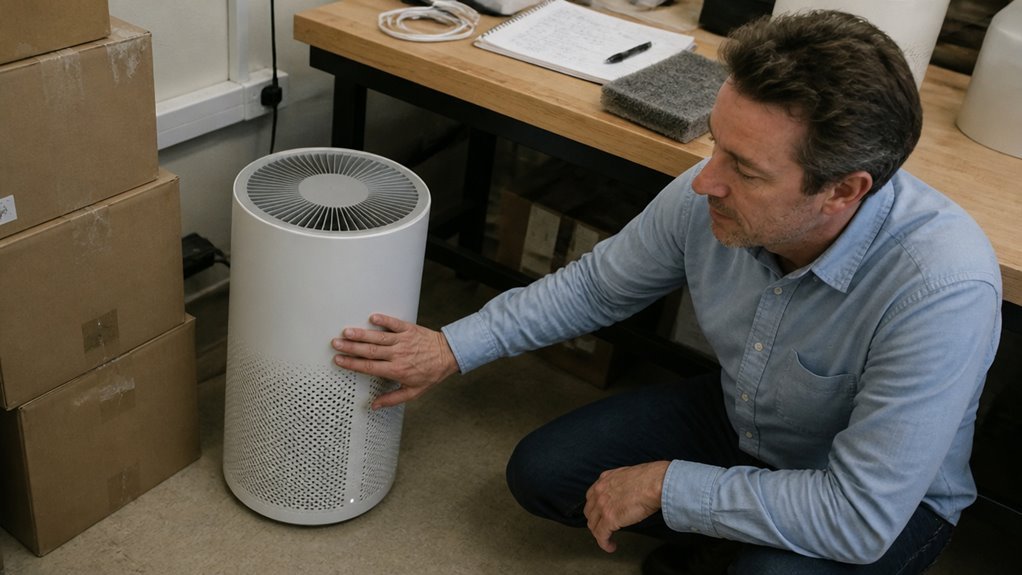
True HEPA and HEPA type labels come from different standards, and only one has a laboratory definition. True HEPA meets the 99.97% capture rate at 0.3 microns, while HEPA type has no legal backing and often performs at 85% to 99% at that same particle size.
Both filters reduce indoor fine particles in real world tests by roughly 52% to 60%, so either choice improves air quality. Allergy sufferers may prefer true HEPA for its verified performance, but budget buyers can still get meaningful particle removal from HEPA type.
The lack of consumer certification means a HEPA claim depends entirely on the box label. For most rooms, the filter replacement cost and noise level matter more than the label difference.
Why Real Rooms Shrink the Gap Between True HEPA and HEPA-Type
Lab tests are clean, sterile, and brutally honest, so a true HEPA filter will always beat a HEPA-type at capturing 0.3 micron particles. Real rooms, though, are messy, leaky, and full of furniture that stirs up dust, which shrinks that lab grade gap fast.
In the Detroit study, indoor PM2.5 reductions, the fine particle pollution you actually breathe, were 60% for true HEPA versus 52% for HEPA-type. The difference between them was so small it wasn’t statistically significant, meaning your couch and open window matter more than the filter’s pedigree.
Real-Room PM2.5
A real room tends to blur the line between a true HEPA filter and its cheaper, HEPA type cousin. In a lab, the 0.3 micron spec is a brutal test, but real rooms are messy, forgiving places. Room size and airflow dynamics matter more than that fancy rating. Bigger spaces mean more air mixing, which dilutes the advantage of the ultra fine capture. A HEPA type filter, with its slightly looser weave, still grabs the vast majority of the bad stuff, especially the larger, heavier particles that settle fast. The true HEPA edge shrinks quietly in the cluttered chaos of your living room, leaving you with a cleaner home and a few extra bucks.
Lab vs. Living Space
A controlled laboratory setting is a unforgiving arena for air filters, but a real room is a messy referee that often calls the fight a draw. In Detroit’s RAPIDS study, true HEPA cut indoor PM2.5 by 60%, whereas HEPA-type managed 52%; the gap shrinks further on personal exposure (53% vs. 31%), yet remains statistically insignificant between the two.
Real rooms leak air, stir dust, and mix particles unpredictably, so lab bragging about peak efficiency carries little weight. No consumer HEPA certification exists, meaning labels are just marketing whispers rather than verified performance promises.
Both filter types typically slash pollution below EPA’s 35 µg/m³ daily limit, so the practical difference lies in long-term exposure, not short-term lab results. Health outcomes depend on consistent daily operation, not on which filter squeezes out a few extra percentage points in a controlled chamber.
A HEPA-type unit delivers near-identical room-level relief for $100 less, making it the sensible purchase for most households. Buy the cheaper one, run it daily, and call it a win.
True HEPA Caught 99.97% of the Hardest Particles; HEPA-Type Didn’t
The sharpest dividing line in air filtration comes down to one particle size: 0.3 microns, which is the hardest size for any filter to catch. True HEPA filters capture 99.97% of particles at that spec, while HEPA-type filters drop to 85–99% efficiency, leaving a wide and unpredictable performance gap.
In lab tests, that difference was substantial. True HEPA’s dense fiber mat held firm, but HEPA-type’s cheaper construction let the toughest particles pass through. The result is like making a free throw under pressure versus hoping for favorable conditions.
Hepa-Type Excelled at 2.0 μM: Where It Matters Less Indoors
The 2.0 micron advantage means little for the air you breathe indoors, since most airborne pollutants settle below that range. Smoke and virus droplets typically measure between 0.1 and 0.3 microns, where a true HEPA filter performs best and a HEPA type filter does not.
A compact portable unit with a low airflow rate cannot translate a lab result at 2.0 microns into meaningful cleaning for a bedroom. The measured win at that particle size does not change how the filter handles the finer particles that actually reach your breathing zone.
Particle-Size Disconnect
The particle size disconnect comes down to how long different sized particles stay in the air you breathe. Two micron particles, roughly the size of a red blood cell, settle onto surfaces within minutes, while sub micron particles linger for hours.
Your air purifier’s HEPA type filter performed well at 2.0 μm, but that performance does little for your lungs. The air you actually inhale carries the sub micron fraction that the filter was designed to capture.
- True HEPA filters target 0.3 μm particles, which penetrate deep into the respiratory system.
- HEPA type efficiency at 2.0 μm looks good on paper but misses the particles that stay airborne.
- Standard filter tests often use uniform particle sizes, not the mixed dust found in real rooms.
- The red blood cell comparison illustrates size only, not how particles behave in airflow.
A 2.0 μm efficiency result does not reflect protection against the particles that matter most. You need a filter that performs well at 0.3 μm to address the fraction that reaches your airways.
Real-World Relevance
The 2.0 μm win for HEPA-type filters is real, but it does little for the particles that matter most indoors. Smoke, virus droplets, and fine dust mostly sit below 1 μm, and the RAPIDS study showed true HEPA cut personal PM2.5 exposure by 53% while HEPA-type managed only 31%.
HEPA-type filters do catch larger pollen and pet dander reasonably well, but they lag on the fine particles that reach deep into airways. Cheaper media also clogs faster, so filter replacement costs rise over a year and often erase the lower upfront price.
Unless you live in a dust balloon factory, true HEPA earns its premium.
Portable Unit Performance
A 2.0 μm particle feels less threatening indoors because those larger particles settle quickly, leaving less time to inhale them. The real indoor threat is the 0.3 μm range, which consumer filter tests often overlook by favoring easy wins with larger particles.
The RAPIDS study showed both unit types cutting indoor PM2.5 by 52 to 60 percent, a statistically meaningless gap. However, true HEPA cut personal exposure by 53 percent, while HEPA type reduced exposure by only 31 percent, and that difference matters for cardiovascular risk.
HEPA type filters vary in performance, with efficiency ranging from 85 to 99 percent at 0.3 μm, so you are gambling on the unit you receive. Both options cost about the same to run at 2 kWh daily, and both operate quietly, so the choice comes down to filtration reliability rather than operating cost.
For allergy relief, a HEPA type unit may suffice, but for reducing cardiovascular risk, choose a true HEPA filter. Save money only if you are willing to accept inconsistent filtration; otherwise, spend the extra for the verified standard.
Choose True HEPA for Bedrooms, HEPA-Type for Tight Budgets
Choosing between true HEPA and HEPA-type filters depends on room use and budget. For bedrooms, true HEPA is the better choice because its 99.97% capture rate at 0.3 microns, the most penetrating particle size, means cleaner air during eight hours of sleep, especially for allergy or asthma sufferers.
True HEPA costs more upfront, while HEPA-type filters run cheaper but vary in efficiency, often capturing 85% to 99% of particles at 0.3 microns. Filter placement matters, so a HEPA-type unit works fine in a living room where you are awake and active, but the same filter in a bedroom means you breathe its output continuously overnight.
Spend where you breathe longest. If money is limited, put a HEPA-type purifier in the main living space and reserve a true HEPA filter for the bedroom.
How to Verify a Filter’s Real Efficiency Before You Buy
You cannot fully verify a filter’s real efficiency before buying, because the government never checks consumer claims and labels like “HEPA-type” blur the line. Instead, trust the numbers and paperwork.
Look for a stated efficiency at 0.3 microns, not just a percentage at a larger particle size, since a true HEPA filter achieves at least 99.97% at that challenging size. Check for an H13 or H14 rating, which matches true HEPA performance, and assume a weaker filter if that rating is missing.
Buy from brands that publish independent lab results rather than their own marketing labels, and compare the clean air delivery rate (CADR) to your room’s square footage. If the price seems too good, it probably is, because true HEPA costs more to manufacture.
- Check for an H13 or H14 rating that matches true HEPA.
- Look for an efficiency figure at 0.3 microns.
- Demand independent lab results and a CADR that fits your room size.
Frequently Asked Questions
Do Government Agencies Certify Consumer HEPA Filters?
Government agencies do not certify consumer HEPA filters through binding regulation. Certification is absent, and labeling standards remain unenforced, so no official verification backs a “true HEPA” claim.
Voluntary industry agreements and independent lab testing are what actually confirm filter performance, not statutory compliance. Look for filters that list their testing standard or use a prefilter to extend the HEPA element’s life. For allergen or smoke concerns, choose a model with a genuine particle filter and follow the manufacturer’s maintenance guidance.
How Often Must True HEPA Filters Be Replaced?
Replacement intervals vary with usage and environment, so most true HEPA filters last 6 to 12 months before needing a change. In a normal home with light use and good prefilter care, you can lean toward the longer end of that range.
Watch for visible dust buildup on the filter surface or a noticeable drop in airflow from the unit, both signal it is time for a swap. The quality of the filter itself also affects how often you must replace it, since denser media can clog faster.
A standardized replacement schedule does not exist for home units, because your room size, pollutant load, and fan speed all change the filter’s workload. Check your unit’s filter indicator or manual for a baseline, then adjust based on the air you actually pull through it.
Are Portable Air Purifiers Effective in Larger Rooms?
Portable purifiers are less effective in larger rooms because airflow distribution becomes uneven as the clean air mixes over a bigger area. Room geometry and the purifier’s placement change how far that airflow reaches.
A single unit can struggle beyond its rated room volume, so multiple devices may be needed for full coverage. Position the unit where nothing blocks its intake and outflow, and run it on a higher fan speed to encourage better circulation.
Does HEPA Filter Noise Increase With Higher CADR?
Yes, higher CADR generally means more noise, because a higher airflow rating requires faster fan speeds. Noise levels rise as fan speed increases, and the relationship is not linear, so small speed changes can produce noticeably louder operation.
That said, the actual sound output depends on the purifier’s design, duct shape, and motor quality. Check the product’s noise specs at each fan speed if quiet operation matters in your bedroom or office, and use sleep mode when you need lower sound.
Can Hepa-Type Filters Worsen Indoor Air Quality Over Time?
HEPA type filters can worsen indoor air quality over time if you neglect maintenance. Mold growth potential increases on captured particles when the filter stays damp or dirty.
Filter bypass leakage permits contaminated airflow around the filter media. This undermines their already reduced filtration efficiency and lets pollutants recirculate.
Replace the filter according to the manufacturer’s schedule and check the seal around the filter frame. Ensure the filter is completely dry before reinstalling it to prevent mold from taking hold.
Rounding Up
Use a True HEPA filter in bedrooms for allergy or asthma relief, and a HEPA Type filter for general dust and pollen in living areas. If your space is large or you have pets that shed heavily, the higher capture rate matters more, so choose accordingly. Always check the manufacturer’s instructions for filter replacement and cleaning to keep the unit effective. For ongoing breathing issues, talk to a qualified medical provider rather than relying on the filter alone. The main condition that changes your choice is the level of respiratory sensitivity in the room.