Air purifiers can help reduce 3D printing particles and some fumes, but results depend on the filter type. Your main concern is likely the air you breathe during long print jobs in a small room.
The right pick depends on the pollutant, since particle filters may not handle resin odors. This article covers HEPA filters, which capture particles down to 0.3 microns, and activated carbon for volatile organic compounds.
It explains noise levels, sensors, and recurring filter costs. Matching the purifier to your printer and room is your next step.
Editorial Highlights
- A multistage purifier with a prefilter, HEPA filter, and activated carbon filter handles 3D printing air best.
- HEPA filters catch fine resin and plastic dust, but they cannot remove the odors and VOCs from styrene and caprolactam.
- Measure the printer first, since a bulky unit can block gantry travel or the Z axis inside an enclosed printer.
- Choose a quiet model rated 35 to 42 dB if you plan to run it overnight near your printer.
- Brushless DC motors bring better efficiency and a longer lifespan, so check the motor type before buying.
| BlueDate 3D Printer Air Purifier for Bambu Lab |  | Best Overall | Filtration Stages: 4-stage (pre-filter + HEPA + activated carbon + HEPA + activated carbon) | Particle Capture Efficiency: 99.97% at 0.3 microns | Fan Speed Control: Stepless speed control, one-button start | SEARCH BEST PRICE | Read Our Analysis |
| Phrozen Air Purifier Max for 3D Printers |  | Quiet Powerhouse | Filtration Stages: 6-stage with activated-carbon layers | Particle Capture Efficiency: 80% odor/VOC absorption | Fan Speed Control: 3-speed (Power, Balanced, Quiet) | SEARCH BEST PRICE | Read Our Analysis |
| Creality Air Purifier for 3D Printers |  | Most Powerful | Filtration Stages: 5-stage | Particle Capture Efficiency: 99.99% dust and odor removal | Fan Speed Control: Not specified | SEARCH BEST PRICE | Read Our Analysis |
| BlueDate 3D Printer Enclosure with HEPA Air Purifier | 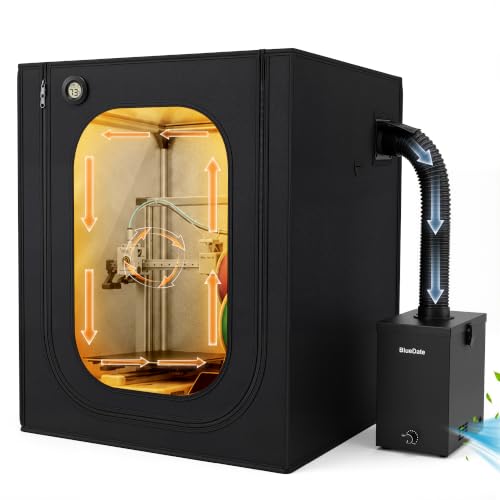 | Best For Enclosures | Filtration Stages: 4-stage (pre-filter + HEPA + activated carbon + HEPA + activated carbon) | Particle Capture Efficiency: 99.97% at 0.3 microns | Fan Speed Control: Stepless speed adjustment, one-button start | SEARCH BEST PRICE | Read Our Analysis |
| ELEGOO Mini Air Purifier for Resin 3D Printers |  | Best For Resin | Filtration Stages: Single-stage (activated carbon) | Particle Capture Efficiency: Activated carbon adsorption (rate not specified) | Fan Speed Control: Single speed (cooling fan ventilation) | SEARCH BEST PRICE | Read Our Analysis |
| ELEGOO MARSMATE Air Purifier for 3D Printers |  | Best For Large Spaces | Filtration Stages: Single-stage (activated carbon) | Particle Capture Efficiency: 95% TVOC removal | Fan Speed Control: Auto low/high switching | SEARCH BEST PRICE | Read Our Analysis |
| 3D Printer Air Purifier with HEPA Filter | 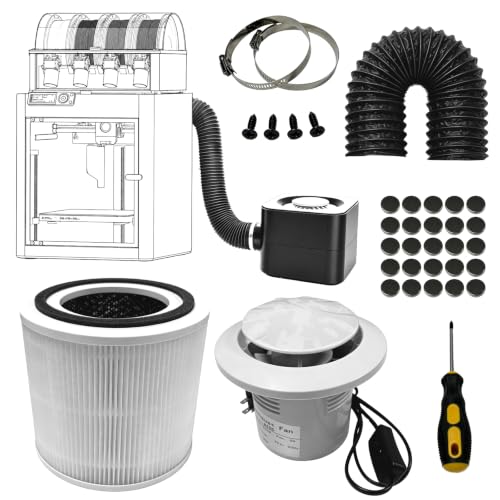 | Best DIY Kit | Filtration Stages: 3-layer (HEPA + activated carbon structure) | Particle Capture Efficiency: HEPA captures fine particles (rate not specified) | Fan Speed Control: Not specified (fan and ventilation pipe included) | SEARCH BEST PRICE | Read Our Analysis |
| Bambu Lab P1S/X1C 3D Printer HEPA Carbon Filter |  | Most Versatile | Filtration Stages: Triple-layer (pre-filter + HEPA H13 + activated carbon) | Particle Capture Efficiency: >99.97% ultrafine particles at 0.3 microns | Fan Speed Control: High-efficiency centrifugal fan (single speed) | SEARCH BEST PRICE | Read Our Analysis |
| Resiners AirPure HEPA Air Purifier with TVOC Display |  | Best For Epoxy | Filtration Stages: 2-stage (pre-filter + H13 HEPA & resin fume filter) | Particle Capture Efficiency: 99.97% at 0.3 microns; 83.59% VOC removal | Fan Speed Control: Auto mode + 3 manual speeds | SEARCH BEST PRICE | Read Our Analysis |
More Details on Our Top Picks
BlueDate 3D Printer Air Purifier for Bambu Lab
If you print on a Bambu Lab X1C, P1S, or ELEGOO Centauri Carbon and want a purifier that sits close to the machine, the BlueDate BD60B is worth a close look. It suits people who want a compact unit built around a printer setup rather than a general-purpose room purifier.
The main strength is its four-stage filtration system, made up of a prefilter, a HEPA filter, activated carbon, and a repeat stage. The maker says it captures 99.97% of particles down to 0.3 microns, which is smaller than a human hair, and links that capture to micro-plastics from PET, ABS, and PC.
The HEPA stage handles fine particles, while the activated carbon stage handles odors and gases. These are separate jobs, so check that both stages match the problem you want to solve.
The unit has a DC brushless motor and a stepless speed dial, so you can change the fan speed during a print. The maker says the airflow also cools the printer quickly.
The metal casing keeps the unit compact. You don’t need to assemble anything, so you can plug it in and start using it.
Compatibility is the key buying detail. The unit fits the Bambu Lab X1C, P1S, and ELEGOO Centauri Carbon. The Bambu Lab P2S needs a riser bracket that you print yourself.
The main limitation is missing information. The product details do not list airflow figures, CADR, room coverage, noise level, power consumption, or filter replacement costs. Check these numbers before buying, especially if the printer sits in a bedroom or office where noise matters.
Choose this unit if you own one of the supported printers and want a purifier designed around that setup. If you need coverage for a large room or want a unit for pet dander or allergies, confirm the airflow, coverage, and noise details first.
- Filtration Stages:4-stage (pre-filter + HEPA + activated carbon + HEPA + activated carbon)
- Particle Capture Efficiency:99.97% at 0.3 microns
- Fan Speed Control:Stepless speed control, one-button start
- Noise Level:Not specified (adjustable per speed)
- Filter Lifespan:Extended via multiple filter design (specific hours not given)
- Compatible Printer Types:Bambu Lab (X1C, X1E, P1S, P2S, P1P, H2D, H2C, H2D Pro); ELEGOO Centauri Carbon and 2 Series
- Additional Feature:Wide voltage range
- Additional Feature:Multiple filter design
- Additional Feature:No printed parts needed
Phrozen Air Purifier Max for 3D Printers
The Phrozen Air Purifier Max suits owners of resin printers who want to reduce fumes without a loud fan. It pulls dust, smoke, and resin odors from the source, so less of the smell reaches your breathing zone.
The filter has six stages, and activated carbon handles the gases. The manufacturer says it removes 80% of VOCs and plastic fumes. Particle filtration and gas removal do different jobs, so the carbon stage is what matters most for resin smells.
The unit has three fan speeds. Power works best for large resin jobs, Balanced fits everyday prints, and Quiet runs at 42 dB for overnight use.
Filter changes are simple. The filter slides out, and the manufacturer says a swap takes about one second. A reminder light signals when a new filter is due, so you don’t have to track the schedule yourself.
Quiet mode moves less air, so it clears fumes more slowly in a large room. The supplied details don’t list room coverage, so measure your space and compare it with the unit’s rated coverage before you buy. Plan for ongoing filter replacement as part of the cost.
Compared with purifiers that rely on particle filters alone, this model adds activated carbon for odor control. That makes it a practical choice if your main concern is resin smell in a home office or shared workspace.
- Filtration Stages:6-stage with activated-carbon layers
- Particle Capture Efficiency:80% odor/VOC absorption
- Fan Speed Control:3-speed (Power, Balanced, Quiet)
- Noise Level:42 dB
- Filter Lifespan:Not specified
- Compatible Printer Types:Resin (LCD) and FDM printers (universal)
- Additional Feature:Slide-out filter swap
- Additional Feature:Smart reminder light
- Additional Feature:Three-speed fan control
Creality Air Purifier for 3D Printers
The Creality air purifier suits makers who want proof that their air stays clean during long printing sessions. Its digital PM2.5 display shows particle levels live, so you can watch the air quality change instead of guessing.
The 250 m³/h motor and 1700 Pa of suction are rated to cover a whole room without disturbing your prints. The product information does not list a noise level, so check that detail before you buy if quiet operation matters to you.
The filters last 1,000 to 1,500 hours before they need replacing. The maker says you will swap them less often thanks to 98% utilization. Five filtration stages target dust and odors, and the maker claims they remove 99.99% of both.
For resin fumes, the 1.4KG version is the model to consider, since the product information says it handles heavier VOC loads. The PM2.5 display tracks particles only, so it does not confirm how well the unit removes gases.
This purifier fits extended sessions better than casual use. If you print a few times a month, the features may be more than you need, and a simpler and less expensive unit may serve you well.
Compared with a purifier that offers no particle readout, this model lets you check air quality yourself. That live feedback is its main difference, and it matters most if you want visible proof rather than assumptions.
- Filtration Stages:5-stage
- Particle Capture Efficiency:99.99% dust and odor removal
- Fan Speed Control:Not specified
- Noise Level:Not specified
- Filter Lifespan:1000 hours standard; 1500 hours V-Fod activated carbon
- Compatible Printer Types:FDM 3D printers (universal)
- Additional Feature:1700Pa suction power
- Additional Feature:PM2.5 digital display
- Additional Feature:250m³/h clean air
BlueDate 3D Printer Enclosure with HEPA Air Purifier
The BlueDate 3D Printer Enclosure with HEPA Air Purifier is designed for people who run an ABS or resin printer in a shared space. It works at the source by sealing the printer inside a shell and pulling fumes through its filters.
The filter system has four stages: a prefilter, a HEPA filter, and two layers of activated carbon. The HEPA filter captures 99.97% of plastic particles down to 0.3 microns, which are the fine particles that reach deepest into the lungs. The activated carbon layers target odors and gases, a job that HEPA filters do not do.
The fire resistant shell holds in heat, reduces noise, and keeps children and pets away from a running printer. A brushless motor with stepless speed control lets you adjust airflow to suit your printer and room. Fan speed changes the balance between air movement and noise, so test a few settings before you settle on one.
The enclosure fits most open frame printers, including models from Bambu Lab and Elegoo. Measure your printer before ordering to confirm it matches the enclosure’s footprint.
The product information does not list a noise level, power consumption, CADR, or filter replacement schedule. Check those figures with the seller before you buy, especially if the printer will run in a bedroom or office where quiet matters. Ask how often each filter needs replacing, since carbon and HEPA filters have different service lives and ongoing costs.
- Filtration Stages:4-stage (pre-filter + HEPA + activated carbon + HEPA + activated carbon)
- Particle Capture Efficiency:99.97% at 0.3 microns
- Fan Speed Control:Stepless speed adjustment, one-button start
- Noise Level:Not specified (noise reduction via enclosure)
- Filter Lifespan:Extended via multiple filter design (specific hours not given)
- Compatible Printer Types:Bambu Lab, Creality, Elegoo, Anycubic, Flashforge open-style and resin printers
- Additional Feature:Fire-resistant enclosure material
- Additional Feature:Guards against children/pets
- Additional Feature:Provides heat retention
ELEGOO Mini Air Purifier for Resin 3D Printers
If resin fumes make your workspace smell like a chemical lab, the ELEGOO Mini Air Purifier is built for that problem. It measures 44×44×107 mm, so it fits inside most LCD printers.
Its activated carbon block absorbs odors while a cooling fan pulls air through it. Carbon removes gases and smells, not dust, pollen, or pet dander, so this unit does not help with allergy symptoms.
Key details:
- Dimensions: 44×44×107 mm
- Fit: Most LCD printers, installed inside the printer
- Power: Rechargeable 2000mAh battery with adapter included
- Runtime: About 24 hours on one charge
- Carbon block life: 3 to 6 months of use
- Replacements: Carbon blocks sold separately
This purifier suits someone with one LCD resin printer who wants to cut the smell without giving up desk space. Because it sits inside the printer, it does not need its own spot on a shelf.
Its main strength is how little room it takes. The product is also described as quiet, which matters if the printer shares a space with you during long print jobs.
The main drawback is ongoing cost. Carbon blocks wear out in 3 to 6 months, and you must buy replacements separately, so factor that into your budget before you order.
Compared with a standalone room air purifier, this unit covers one printer rather than a whole room. Room models often pair a prefilter with a HEPA filter for dust, while this unit relies on activated carbon alone. If you need cleaner air across a bedroom or office, a room purifier fits better. If the goal is odor control at the printer, this unit is a focused and affordable choice.
- Filtration Stages:Single-stage (activated carbon)
- Particle Capture Efficiency:Activated carbon adsorption (rate not specified)
- Fan Speed Control:Single speed (cooling fan ventilation)
- Noise Level:Not specified
- Filter Lifespan:3–6 months per carbon block
- Compatible Printer Types:All LCD resin 3D printers (internal fit required)
- Additional Feature:2000mAh battery capacity
- Additional Feature:24-hour continuous operation
- Additional Feature:Compact rechargeable size
ELEGOO MARSMATE Air Purifier for 3D Printers
The ELEGOO MARSMATE suits people who run large resin printers and want fewer odors in the room. It removes up to 95% of TVOCs, the volatile organic compounds that cause the strong smell of resin printing.
A built in sensor measures concentration and alerts you early when levels rise. That alert helps you act before the smell builds up during a long print.
The activated carbon filter lasts about two months, so budget for a replacement every couple of months. To swap it, remove the upper cover, discard the plastic bag around the new filter, and press reset.
The unit uses a duct design that automatically adjusts fan speed. It draws only 6W and runs at 35dB, so it stays quiet enough to leave on beside a desk during extended prints.
It fits the Mars 4 DLP, Saturn 2, Jupiter, and other resin printers with an extension port. Confirm that your printer has this port before you buy.
Its main limitation is its narrow purpose. The carbon filter targets gases and odors, and the product information does not mention a particle filter, so do not rely on it to capture dust, pollen, or smoke. It also focuses on the printer’s surroundings rather than general room air.
Choose the MARSMATE if your main concern is resin fumes from a compatible printer and you want a quiet unit that warns you when the air needs attention.
- Filtration Stages:Single-stage (activated carbon)
- Particle Capture Efficiency:95% TVOC removal
- Fan Speed Control:Auto low/high switching
- Noise Level:35 dB
- Filter Lifespan:Up to 2 months per filter
- Compatible Printer Types:ELEGOO Mars/Saturn/Jupiter series and other resin printers with extension port
- Additional Feature:VOC sensor with early alert
- Additional Feature:Ultra-low 6W power draw
- Additional Feature:Filter reset button
3D Printer Air Purifier with HEPA Filter
The JUYINebule Core300 RF White suits people who run desktop 3D printers in a home workshop and want filtration built around that setup. You assemble this kit yourself by printing the housing from the provided STL files before the unit runs.
Its strongest feature is the filter cartridge, which pairs a HEPA filter with three layers and activated carbon. The HEPA layers catch the fine plastic particles that printing releases, and the activated carbon targets odors.
The main drawback is the setup work. You need printing time, patience, and the included screwdriver before the purifier is ready to use. Plan to replace the cartridge regularly so the filtration keeps working as intended.
The kit includes a fan, filter cartridge, ducting, clamps, screws, magnets, and a screwdriver. You will still need printer time and filament to make the housing.
Compared with ready-made air purifiers, this kit gives you more control over placement. The clamps and magnets help you position the unit near your printer.
It is rated for most desktop FDM printers, so confirm that your printer model fits before you order. Noise level, airflow, and power consumption are not included in this product description, so compare those figures before you buy if quiet operation matters in your workshop.
- Filtration Stages:3-layer (HEPA + activated carbon structure)
- Particle Capture Efficiency:HEPA captures fine particles (rate not specified)
- Fan Speed Control:Not specified (fan and ventilation pipe included)
- Noise Level:Not specified
- Filter Lifespan:Regular replacement recommended (specific lifespan not given)
- Compatible Printer Types:Most desktop FDM 3D printers (universal)
- Additional Feature:DIY kit self-assembly
- Additional Feature:Customizable shell via STL
- Additional Feature:Includes aluminum foil duct
Bambu Lab P1S/X1C 3D Printer HEPA Carbon Filter
Bambu Lab P1S and X1C HEPA Carbon Filter
This filter suits owners of enclosed 3D printers, including the Bambu Lab P1S and X1C, who want to cut down on fumes and particles while they print. It combines a prefilter, a true HEPA H13 filter, and activated carbon in one unit.
The HEPA layer captures fine particles down to 0.3 microns, with a rated efficiency of 99.97 percent. The activated carbon targets gases such as styrene and caprolactam, so each layer handles a different type of pollutant.
The fan moves 60 cubic meters per hour and keeps the enclosure under steady negative pressure, which pulls air through the filter. It does this without changing your print temperatures.
Replacing the filter takes no tools. Pop out the old unit, click in the new one, and check the manual for the filter replacement schedule.
The filter only cleans air inside a closed printer enclosure, so it will not clean a bedroom or office. Its carbon layer targets the gases named here, not every odor in your home.
Compared with a standalone room purifier, this unit is sized for one printer and does not need to cover a room. You can also print adapters to fit Creality, Prusa, or Anycubic machines, so it is not limited to Bambu printers.
- Filtration Stages:Triple-layer (pre-filter + HEPA H13 + activated carbon)
- Particle Capture Efficiency:>99.97% ultrafine particles at 0.3 microns
- Fan Speed Control:High-efficiency centrifugal fan (single speed)
- Noise Level:Not specified
- Filter Lifespan:Tool-free quick-swap modules (specific lifespan not given)
- Compatible Printer Types:Bambu Lab P1S/X1C; adapter kits for H2S/H2D, P2S, Creality K2, Prusa, Flashforge, Anycubic, Elegoo, Sovol
- Additional Feature:60 m³/h airflow capacity
- Additional Feature:Tool-free quick-swap filters
- Additional Feature:Adapter kits for other printers
Resiners AirPure HEPA Air Purifier with TVOC Display
The Resiners AirPure suits resin crafters who work in a small room and want to monitor their air. It covers 158.76 square feet, so it fits a craft nook or spare room better than a large open studio.
The H13 HEPA filter handles particles. The listing says it captures 99.97% of particles down to 0.3 microns, including smoke, allergens, and fine resin dust. A prefilter catches hair and larger dust first, so less debris reaches the HEPA filter.
Epoxy and resin fumes are gases, so they need separate handling from particles. The listing reports 83.59% VOC removal, tested by SGS. That number means the unit reduces fumes but does not clear them completely, so open a window or run a fan when you pour or coat.
The TVOC display shows air quality with green, yellow, or red lights, along with temperature and humidity. You can see when fumes rise and when the room clears, which helps you decide when to step out. The display makes it easier to judge the air without guessing.
Auto mode adjusts fan speed based on the air quality reading. You can also pick one of three fixed fan speeds and set a timer up to 9 hours. The timer is useful for running the unit after a session so the room keeps clearing while you are gone.
The filter is rated for 2,000 hours of use. Track how many hours the unit runs, and check the replacement filter price before you buy, since the listing does not include one.
The listing does not state a noise level or power consumption. If you plan to run it overnight in a bedroom, check the spec sheet or reviews for decibel readings first.
Compare this model with other picks on three points: the VOC removal rating, the live TVOC display, and the timer. If a competing model lacks a gas removal rating or a live air quality readout, the AirPure gives you more information about fumes. If your main concern is dust and pollen in a larger room, look for a purifier with a higher coverage rating.
The unit is CARB compliant, meaning it meets California Air Resources Board standards. That matters most if you live in California or plan to buy there.
- Filtration Stages:2-stage (pre-filter + H13 HEPA & resin fume filter)
- Particle Capture Efficiency:99.97% at 0.3 microns; 83.59% VOC removal
- Fan Speed Control:Auto mode + 3 manual speeds
- Noise Level:Not specified
- Filter Lifespan:Up to 2000 hours; replacement every 3–6 months
- Compatible Printer Types:Resin crafting environments and general home use
- Additional Feature:SGS-certified VOC removal
- Additional Feature:360-degree intake design
- Additional Feature:CARB-compliant certification
Factors to Consider When Choosing Air Purifiers for 3D Printing

Before you buy an air purifier for your 3D printing space, weigh filtration depth, motor power and noise, printer compatibility range, filter lifespan and cost, and physical size and portability. Filtration matters most, because a HEPA filter captures fine particles, while activated carbon handles volatile organic compounds (VOCs), the gases that cause odors.
Check the specifications for both filter types instead of relying on the product’s headline features. Match the unit to your printer’s footprint and your budget so that the purifier fits your workspace and that you can keep it running.
Filtration Technology Depth
Filtration depth determines how well an air purifier handles the pollutants in your room. A unit with only one filter stage covers a narrow range of pollutants, so a multistage design is the better choice.
A multistage purifier typically combines three layers that work in sequence. Each layer removes a different type of pollutant.
- A prefilter that captures dust and larger particles.
- A HEPA filter that captures 99.97% of particles down to 0.3 microns.
- Activated carbon that removes volatile organic compounds (VOCs) such as styrene from ABS or caprolactam from nylon. HEPA filters cannot trap these chemicals.
Carbon quality varies widely between models. Standard carbon lasts about 1,000 hours, while upgraded versions last 1,500 hours or more, so check the spec sheet before you buy.
Efficiency ratings for odor removal range from 80% to 99.99%. The gap between a low rating and a high one shows how much the carbon actually reduces odors, so compare these figures across models.
Real time VOC or PM2.5 sensors show whether the purifier is removing pollutants and alert you when a filter is losing effectiveness. Look for these sensors if you want confirmation that the unit is doing its job.
Filtration depth matters most when odors and gases are part of your concern, because a particle filter alone cannot address them. Paying for a deeper filtration system gives you more complete cleaning for both particles and gases.
Motor Power and Noise
A filter can only clean air that actually passes through it, so the motor matters as much as the filter itself. Manufacturers express this performance as clean air delivery rate (CADR), which measures how many cubic meters of air a purifier cleans per hour.
A more powerful motor moves air faster, so the unit clears odors and fumes more quickly. Stronger motors often produce more noise, which is measured in decibels (dB).
Ratings between 35 and 42 dB are quiet enough for overnight use, while anything above 50 dB may wake people in nearby rooms. Many manufacturers do not list dB values at all, so check the specifications before you buy.
Brushless DC motors are more efficient, last longer, and run more smoothly than brushed motors. Stepless speed control lets you lower the airflow when you need quiet and raise it when you need faster cleaning.
Choose a purifier with a strong motor and variable speeds so you can trade airflow for quiet when the situation calls for it. Running the unit at high speed clears the air faster, while a lower setting keeps the noise down during sleep or quiet work.
Printer Compatibility Range
Physical fit is the first thing to check, before you compare filter specifications. An air purifier that cannot share space with your printer is wasted money, regardless of its filter quality.
Enclosed printers need a unit designed for chamber airflow. On an open frame printer, filtered air simply escapes into the room.
Many setups also need a printed adapter bracket to mount the unit, so search online for an existing design before you buy.
Universal desktop units fit most FDM printers, but resin printers with a vat often leave little room. For resin, look for a unit with a ventilation port extension, and for FDM printers, make sure the setup does not disrupt chamber temperature stability.
Measure the space around your printer, because a bulky unit can block the gantry’s travel path. Side mounted units can also interfere with the build plate’s Z axis movement.
Check the mount style, whether top, side, or standalone, against the printer’s moving parts before you buy. If the unit fits, it will work with your printer, and if it does not, it adds cost without adding value.
Filter Lifespan and Cost
The replacement schedule is where the ongoing cost of an air purifier shows up, and many buyers overlook it until they are buying new filters every few months. Filter lifespans run from 1,000 to 1,500 hours, which works out to roughly two to six months depending on your printing volume.
A compact unit with a small carbon block may need a new filter in about two months, while a larger 1.4 kg carbon block used for heavy resin printing can last about six months. Over time, the replacement schedule shapes what you actually spend on the unit.
Choose a unit with a prefilter, which catches large debris before it reaches the HEPA filter and activated carbon and slows their clogging. Divide each filter’s price by its lifespan to compare monthly cost, since a filter that costs less per replacement can still be the cheaper choice over time. These comparisons only hold if you print enough to use each filter’s full lifespan, so check the rated capacity before you buy.
Physical Size and Portability
Size determines where a purifier fits around your printers. Compact models with durable ABS casings sit right beside the printer and need no mounting hardware.
- Mini cylindrical units, measuring 44 × 44 × 107 mm, fit inside resin chambers, but their small filters wear out quickly, so you will replace them often.
- Rechargeable units with a 2000mAh battery let you move between printers without a cable, but you must check chamber clearance and keep the battery charged.
- Larger units, roughly 210 × 247 × 410 mm, offer longer filter life and stronger airflow, but they suit a fixed station better than a space you rearrange often.
- Enclosure integrated models, measuring 650 × 750 × 800 mm, are designed to trap fumes and noise, but they occupy considerable floor space.
Choose the size that matches how you work. Portable units suit people who move printers around, while larger units suit a dedicated corner.
Frequently Asked Questions
Do These Purifiers Remove Resin Fumes Completely?
Do These Purifiers Remove Resin Fumes Completely?
No, a purifier cannot remove resin fumes completely. Even higher quality models reduce volatile organic compounds significantly, but trace odors can still linger.
Pair the purifier with ventilation to bring fresh air into the room, since the two work together to keep the air breathable. If you notice symptoms from resin fumes, contact a qualified clinician.
How Often Must the HEPA Filters Be Replaced?
How Often Must the HEPA Filters Be Replaced?
Replace your HEPA filter every 6 to 12 months, based on how often the purifier runs and how polluted the air is. Do not wait for visible dirt.
Check the filter indicator or the pressure drop reading if your model has one, and follow the manufacturer’s guidelines. Choose a filter that traps ultra-fine particles well, because cheaper filters may not capture them effectively.
Can One Purifier Cover Multiple Enclosed Printers?
Can One Purifier Cover Multiple Enclosed Printers?
No, one purifier cannot cover multiple enclosed printers. Each enclosure needs its own unit for effective filtration.
Sharing a single unit across several enclosures leaves at least one printer without proper filtration. Plan on one purifier per enclosure so every printer is covered.
Are Carbon Filters Recyclable or Refillable?
Are Carbon Filters Recyclable or Refillable?
Most carbon filters are not recyclable, but many are refillable. In a refillable unit, you replace only the saturated activated carbon granules instead of the whole filter.
Check the manufacturer’s instructions to confirm whether your purifier uses refillable carbon media. Reusable media cuts waste and saves money.
Do Purifiers Affect Print Chamber Temperature?
Yes, an air purifier can lower print chamber temperature, and the effect depends on placement and fan speed. The unit pulls warm air out of the enclosure and pushes cooler room air in, so the chamber temperature drops slightly.
Expect only a small change, and confirm the reading with the printer’s own temperature sensor while the purifier runs.
When sizing an air filtration system for your home, make sure you verify the True HEPA certification grade. Our laboratory testing confirms that carbon bed weight determines VOC and odor adsorption capacity.
If you need step-by-step diagnostic advice, review our lab benchmarks in UV-C Bulbs in Air Purifiers: Exposure Time & Reality. We also strongly recommend studying Gas Stove Nitrogen Dioxide Health Risks: Asthma Links to optimize replacement schedules.
Rounding Up
Run your air purifier and ventilate the room every time you print.
Ventilation matters most in small, enclosed spaces, where pollutants can build up faster.
Resin and filament printers release different pollutants, so the filter you need depends on your machine.
Replace filters and clean the unit as the manufacturer directs, because a worn filter captures less.
If you notice breathing problems or other symptoms, speak with a qualified doctor.