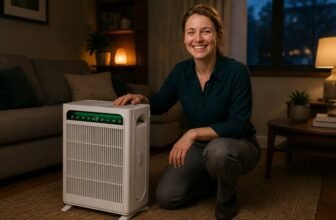
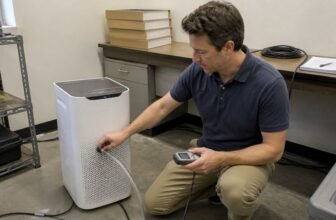
If you are weighing a do it yourself air cleaning box against a commercial purifier, the biggest difference comes down to clean air delivery rate. The DIY design moves far more air overall, while the commercial unit captures smaller particles more effectively. Your choice depends on whether you prioritize total airflow or finer filtration.
This article breaks down the airflow and noise benchmarks for both options. It also explains how fine particle capture compares.
Choose the purifier that best matches your room size and the specific pollutants you want to address.
Air Purify Highlights
- A Corsi Rosenthal box moves more air overall than a commercial HEPA, but the HEPA captures smaller particles better.
- Choose the commercial HEPA when you need quiet operation and can place it near a corner.
- Build the Corsi Rosenthal box if your main concern is moving large volumes of air on a budget.
- The commercial HEPA wins for smoke removal because its fine particle capture makes up for lower airflow.
- Pick the DIY box when noise at low speed is acceptable and you want to cut annual costs.
CADR per Dollar: Why the $120 DIY Beats the $549 HEPA

A budget build with a single 5 inch filter and a box fan delivers more clean air per dollar than a premium commercial purifier. The DIY unit moves about 405 cubic feet per minute, while the HEPA model manages roughly 282 cubic feet per minute at a significantly higher price.
Fan speed changes the tradeoff between airflow and noise. On high, the box fan produces noticeable sound, but on low it still outperforms many commercial HEPA machines at their maximum setting with a tolerable hum.
- DIY setup: lower upfront cost, higher airflow, filter replacement once a year.
- Commercial HEPA unit: higher upfront cost, lower airflow, filter replacement at a steeper ongoing expense.
Commercial purifiers win on quiet operation, but that whisper comes at a luxury markup. For anyone watching their budget, the DIY option offers more CADR for less money.
CR Box vs. HEPA: Where the Clean Air Numbers Really Diverge
The Corsi Rosenthal box and a commercial HEPA purifier diverge sharply once you compare airflow and reach. The box wins on raw clean air delivery rate, hitting 471 cfm at low speed, but that figure hides a practical catch.
Thicker MERV 13 panels reduce pressure, so airflow drops unless you raise the fan speed, which turns the room into a wind tunnel. Tape gaps in the box seal cost about 20 percent efficiency, and placement matters because the box works best centered in a room rather than in a corner.
HEPA units push clean air farther from their position, making them more forgiving of corner placement. Choose HEPA when you need quiet, targeted cleaning; choose the box for budget friendly brute force, but expect noise and draft.
Can a DIY Box Fan Run Quiet Enough for a Bedroom?
A DIY box fan can be quiet enough for a bedroom, but only when you run it on its lowest speed. At maximum speed, a four filter Corsi Rosenthal box produces about 76 dBA, which is closer to a leaf blower than a lullaby, while the lowest setting drops the noise to roughly 46 dBA, matching the quiet mode of a commercial purifier.
Most sleepers tolerate 40 to 50 dBA, and at that low setting the box fan still moves about 471 cubic feet per minute, which is far more airflow than typical retail units deliver. You get clean air, not a windstorm, so plan for a gentle hum rather than a breeze if you want to sleep through the night.
- CR box at max speed: 76 dBA
- CR box at lowest speed: ~48 dBA
- Single filter DIY box: ~42 dBA
- Common retail purifier on medium: 46 dBA
- Larger retail purifier on high: 59 dBA
Why Airflow Beats Filter Grade in Real Rooms
A box fan on low moves more air than a pricey filter, and that airflow outperforms filter grade in a real room. A simple fan filter unit at 471 cubic feet per minute processes nearly double the air of a premium standalone purifier at 282 cfm.
Filter efficiency only matters when air actually passes through the media. A HEPA filter catches 97 percent of particles at 0.3 microns, but it processes that air at a slower rate than a MERV 13 filter, which grabs 85 percent of particles at 1 to 3 microns while moving far more cubic feet per minute.
That higher volume results in more total particles removed per hour, which is the key metric for room air. A low cost, single fan filter setup on its lowest speed can quietly outperform a costly HEPA purifier on total particle removal.
Prioritize airflow first, then filter grade, for everyday room cleaning.
What CADR Benchmarks Miss: Particle Size and Real-World Setup
CADR ratings depend heavily on the particle size used in the test, which is why the numbers can mislead. Benchmarks often use smoke at 0.09 to 1 µm or pollen at 5 to 11 µm, but real room air contains a mix of sizes that falls between those extremes.
A Corsi Rosenthal box scores 166 cfm on smoke and 464 cfm on pollen with the same fan and filters, while a HEPA unit scores 282 cfm on smoke and about 220 cfm on particles from 3 to 10 µm. That gap reflects physics, not marketing, because a MERV 13 filter captures only 50 percent of 0.3 µm particles but 90 percent of 5 µm particles.
- 0.09 to 1 µm: CR box 166 cfm, HEPA unit 282 cfm
- 1 to 3 µm: CR box 321 cfm, HEPA unit about 250 cfm
- 3 to 10 µm: CR box 464 cfm, HEPA unit about 220 cfm
- 0.3 µm worst case: CR box about 150 cfm, HEPA unit 270 cfm
Leaky seams also cut performance, since duct tape gaps can reduce efficiency by 20 percent. For fine particles near 0.3 µm, a HEPA filter wins, but for the mixed dust found in actual rooms, a DIY box often delivers higher airflow.
Frequently Asked Questions
How Often Should I Replace the MERV-13 Filters?
Replace your MERV-13 filters every 3 to 6 months, but your specific timeline depends on how often the unit runs and how much dust, pollen, or pet dander it captures. If you live in a dusty home or run the system continuously on a higher fan speed, you will need to change them closer to the 3 month mark.
Watch for a drop in airflow or a rising filter replacement indicator, as both signal that the filter is clogged and less effective. Changing the filter before it becomes fully blocked keeps your air clean and your system working efficiently without straining.
Does Tape Type Affect the CR Box’s Performance?
Tape type matters marginally, but tape seal integrity is what prevents bypass airflow. Weak adhesion degrades efficiency over time, yet frame rigidity is the main driver of overall performance.
Proper taping sustains CADR by keeping air moving through the filter, while structural support governs total output. For best results, use a tape that holds firmly and reapply it whenever the seal lifts, but focus your setup on a sturdy frame first.
Can I Use a Window Fan Instead of a Box Fan?
A window fan is not the right choice for filtration because its design and airflow fail against the added resistance of a filter. The smaller fan blade and limited speeds drastically reduce airflow and CADR compared to a standard box fan.
This lower performance compromises the filtration effectiveness, so the air in your room won’t be cleaned as well. For best results, use a box fan with a filter attached, as it delivers the higher airflow needed to overcome filter resistance.
What Is the Safe Distance From Walls for Airflow?
Keep the purifier at least 12 inches away from walls and large furniture. This clearance protects the air intake from corner turbulence that starves the filter. Obstructions reduce the fan’s ability to pull air, which directly lowers your clean air delivery rate.
Place the unit where nothing blocks the intake on any side, including curtains and cables. A clear perimeter lets the fan draw room air evenly, so the HEPA filter captures more dust and pollen. The quiet guardian of performance is distance, and even a small gap prevents airflow from bouncing back and choking the system.
Will the CR Box Reduce Odors and Gases Effectively?
The CR box is not effective for odors and gases because its MERV-13 filters lack activated carbon. VOC adsorption is minimal, so gaseous pollutants remain unaddressed.
This setup primarily targets particulate matter, not chemical contaminants. For odors and volatile organic compounds, you need a filter layer with activated carbon. Place the CR box where airflow is unobstructed, and pair it with a separate gas phase filter if your main concern is chemical smells.
Rounding Up
Build the box fan filter first, because it delivers the best cleaning speed for the least money in typical rooms. Choose a quieter commercial unit instead if noise bothers you during sleep or close work, since the fan style is loud on high.
For better results, place the unit to maximize airflow across the room and keep the filter media fresh per the manufacturer’s instructions. Leaks around the frame cut performance, so seal them well and check the fan speed setting.
The tradeoff comes down to your tolerance for sound over raw air movement, so pick based on that condition.