Wondering whether an air purifier can truly handle a large 635 square foot room starts with understanding its clean air delivery rate. That rating depends on how many cubic feet of air the unit moves per minute, which directly determines how often the whole room gets filtered.
For most spaces with standard eight foot ceilings, a strong unit can achieve five air changes per hour, meaning a complete clean cycle every twelve minutes. Taller ceilings slow this turnover, so you may need a more powerful model to keep up.
This article breaks down the air change benchmarks you need, explains how room height affects performance, and covers what to expect when tackling heavy smoke. Look for a purifier that matches both your room size and your main air quality concern.
Air Purify Highlights
635 square feet works for an 8 foot ceiling with the fan pushing 410 CFM.
Taller ceilings shrink that coverage because the air volume grows faster than floor space.
Place the unit near the middle and keep three feet of open space around it for good airflow.
A room with a 12 foot ceiling needs a stronger fan or a smaller floor area rating.
In real living rooms, that airflow cuts dust and smoke readings by 93 to 96 percent within an hour.
Why 5 ACH Equals the 635 Sq Ft Core 600S Rating

The Core 600S rating of 635 square feet follows from a straightforward calculation: 410 CFM of airflow against an 8 foot ceiling produces five air changes per hour. This means a full clean cycle occurs every twelve minutes for a room of that size.
This air changes per hour target assumes an average ceiling height. If your ceiling is taller, the effective coverage will drop slightly, since the room volume increases while the airflow stays fixed.
For most standard living rooms near that square footage, this rating balances power and affordability well. Compare it against other units with similar clean air delivery rate numbers, and you will find few that advertise this efficiency at this price point.
Match ACH to Your Room Size: 8, 4.8, or 2
The Core 600S’s advertised 635 square foot coverage depends on a brisk 5 air changes per hour, but that single benchmark masks how room size changes performance. For a quick refresh, 8 air changes per hour suits rooms up to 405 square feet, while the standard 4.8 rate covers 645 square feet, and a relaxed 2 rate extends to 1,588 square feet with an 8 foot ceiling.
Choose the rate that fits both your space and your patience, because larger rooms inevitably get slower turnover. That trade off is a natural consequence of room volume, not a design flaw.
Air Changes Per Hour
Air changes per hour, abbreviated ACH, determines whether an air purifier effectively cleans a room or merely runs without benefit. The Levoit Core 600S matches its airflow to room volume, so ceiling height, assumed at 8 feet here, matters as much as floor area.
ACH calculation basics divide the purifier’s clean air delivery rate by the room’s cubic feet. At 8 ACH, rapid smoke or VOC cleanup occurs in spaces of 405 ft² or less, with a full air pass every 7.5 minutes.
At 4.8 ACH, the AHAM standard, coverage extends to 645 ft², refreshing air about every 12.5 minutes. At 2 ACH, the minimum for normal conditions, coverage reaches 1,588 ft², but each air cycle takes 30 minutes.
Match ACH to your actual pollutant load, not just room size. Higher ACH suits smoky or chemically active spaces, while lower ACH works for routine particle filtration.
Matching Room Dimensions
The Core 600S matches airflow to your room’s actual volume, not just its labeled coverage. The 635 ft² rating assumes an 8 foot ceiling; a 10 foot ceiling adds 20% more air, which the unit clears at a slower air changes per hour rate.
Furniture placement changes performance, so keep three feet of clearance on all sides and position the unit centrally. A couch blocking the intake restricts airflow like a pillow over your mouth.
For standard rooms, 4.8 air changes per hour are sufficient. If you cook often or have pets, use 8 air changes per hour for smaller spaces.
Measure your room volume, including ceiling height, to set the right expectation. That calculation, not square footage alone, determines how quickly fine particles and pet dander get removed.
Adjusting ACH Rates
Match the ACH rate to the room’s actual pollution load, not just its square footage, because the fan speed determines how many times per hour the air cycles. Choose a target of 8, 4.8, or 2 based on what is happening in the space, such as smoke or cooking, rather than the size alone.
Use 8 ACH for heavy pollution from incense, pets, or VOC fumes, which suits rooms up to 405 ft² and cleans the air in about 8 minutes. Use 4.8 ACH as a standard sweet spot for typical living areas up to 645 ft², with a 13 minute cycle.
Use 2 ACH for light duty in bedrooms or low activity zones up to 1588 ft², taking 30 minutes per cycle. Crank the fan for quick fixes and drop it for quieter nights, since airflow tuning here is straightforward.
Benchmark comparisons show that room size calibration matters less than pollutant intensity. Match the rate to the mess, not the meter, and the air cleaner will handle the load effectively.
How 2 ACH Reaches 1,588 Sq Ft for Larger Spaces
The 1,588 square foot figure assumes only 2 air changes per hour, meaning the purifier moves the full room volume twice each hour instead of five times at its 635 square foot rating. This slower exchange suits open plan living areas, where one unit can address separate zones like a kitchen and family room without needing a second device.
The trade off is slower particle removal for broader coverage, which leads to higher energy consumption over time. Running the unit on high for longer stretches uses more power, though the 49 watt draw keeps the cost manageable for a large basement or combined loft.
This setting works for steady, whole space cleanliness rather than rapid response to a sudden pollutant source. It is a practical compromise for anyone who wants consistent filtration across a larger area without overstating the unit’s capability.
Push to 2,909 Sq Ft With 1 ACH and VortexAir
The 2,909 sq ft rating is a ceiling, not a target, because it assumes only one air change per hour, the bare minimum for noticeable filtration. At that low ACH, VortexAir’s airflow design mainly helps push air to distant corners, but smoke or odor removal in such a large space will feel slow.
For any room larger than a typical living room, you should plan on the 2 ACH setting instead. That higher rate gives you more responsive cleaning, though it also means more power consumption and potentially more noise from the unit.
VortexAir Room Expansion
Large rooms can make air delivery complicated, but the Core 600S solves that by letting you lower its turnover setting. At the lowest setting, coverage expands to 2,909 ft², which suits a warehouse, a loft, or a very open kitchen plan.
One air change per hour means the entire room’s air passes through the unit once every 60 minutes, which works for light maintenance but not for heavy smoke events. The VortexAir airflow pattern pushes clean air toward corners, yet ceiling height, furniture blocking, and open doorways all reduce that stated coverage.
The clean air delivery rate stays at 410 CFM, so this setting trades speed for spread rather than increasing raw power. For a large, calm space the unit performs well, while a party room demands a smaller footprint and accepted compromise.
Know your room’s volume and layout before trusting the spec sheet. Select the turnover setting that matches your activity level, and remember that airflow, not wattage, determines how quickly pollutants clear.
Extended Coverage Limitations
The Core 600S covers its stated 2,909 ft² only at one air change per hour, which translates to a full room cycle every 60 minutes. That pace works if you accept slow purification, but a typical daily use room of 635 ft² gets far more effective turnover.
Ceiling height changes the math because the coverage figure assumes an 8 foot ceiling. A 10 or 12 foot ceiling increases room volume, so the same airflow delivers fewer air changes per hour and shrinks useful coverage.
Extended coverage also forces you into Turbo mode, which produces a 58.7 dBA noise level that is not sleep friendly. For quiet operation and steady filtration, keep the unit sized to the smaller daily footprint rather than chasing the maximum marketing claim.
Real Proof: 560 and 730 Sq Ft Room Test Results
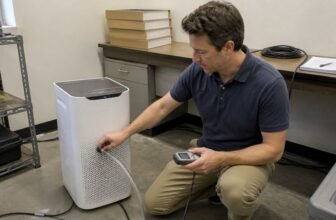
Independent tests placed the purifier in two real rooms, 560 and 730 square feet, and measured air cleaning speed at maximum fan speed. In the 560 square foot space, the AQI fell from 137 to 6 within an hour, a 96% improvement in air quality.
The 730 square foot room dropped from 136 to 10, a 93% improvement, showing slightly slower but still effective performance. The 560 square foot test reached near pristine levels, confirming the 635 square foot coverage rating is realistic.
Both sessions verified dramatic AQI reduction outside a laboratory setting. Oversized rooms handle the load without issue, as the 730 square foot result demonstrates.
What the 410 CFM CADR Rating Means for Big Rooms
A 410 CFM clean air delivery rate means the machine can cycle a large room’s entire volume quickly, which is what makes it effective for spaces around 635 square feet with eight foot ceilings. That room holds roughly 5,080 cubic feet, and at 410 CFM the air turns over every 12 minutes, a solid baseline for noticeable clean air.
Placement matters as much as the airflow rating, because central positioning prevents dead zones where dust settles. For a big room, this CADR level is not hype; it is the minimum needed to keep the whole space actively filtered.
Pick Your ACH: Smoke, Standard, or Normal Air
Air changes per hour, or ACH, tells you how many times the purifier filters the entire room volume each hour, and it matters more than the square footage claims. Your choice depends on how fast you need relief, not just room size.
For smoke or spaces heavy with volatile organic compounds, aim for 8 ACH, which covers up to 405 ft² and suits kitchens or wildfire season. Standard conditions use the AHAM benchmark of 4.8 ACH for 645 ft², balancing speed and noise.
Normal air needs only 2 ACH, covering 1588 ft² with slower cleanup of roughly 30 minutes per cycle. The 410 CFM CADR rating shows strong airflow, but sensor accuracy varies, so auto mode may lag in real smoke.
Frequently Asked Questions
Does the 635 Sq Ft Rating Assume an 8-Foot Ceiling?
Yes, the 635 sq ft rating assumes an 8 foot ceiling. The rating is tied to room volume, not just floor area, so a taller space changes how well the purifier performs.
A larger room volume dilutes airborne particles faster, which means you would need more airflow to reach the same level of cleanliness. Treat the covered square footage as a starting point for standard height rooms.
For vaulted ceilings or open floor plans, focus on your specific air changes per hour needs. Use a particle sensor or run the unit on a higher fan speed to maintain clean air in that taller space.
How Does the Core 600S-P Variant Differ in Room Coverage?
The Core 600S-P variant delivers a lower CADR of 391 CFM, which reduces its ideal room coverage to roughly 605 square feet at five air changes per hour. This means the unit suits smaller open spaces, while larger rooms will see slower overall cleaning cycles.
Sensor accuracy stays identical between the models, so pollutant detection remains reliable. The reduced airflow capacity, however, extends the time needed to reach the same air quality level in a given space.
What Is the Actual Noise Level at Sleep Mode?
Sleep mode decibels measure 43.9 dBA independently, which exceeds the manufacturer’s 26 dB claim. This low fan speed curve still operates quietly, though it is louder than specified, placing it as a moderate whisper for nighttime use.
At this level, you will hear a soft continuous hum, but it should not disrupt most sleepers. For quieter operation, place the unit farther from your bed and keep the air intake clear of obstructions.
The gap between the claimed and real noise level matters most in a small bedroom. Check your unit’s manual for placement guidance and for how the sleep mode interacts with any particle sensor.
How Often Should I Replace the HEPA Filter?
Replace the HEPA filter every twelve months for best performance, but your actual schedule depends on usage and air quality. The built-in indicator gives the most accurate timing for your home, so follow it rather than a fixed calendar date.
For heavy use or smoky, dusty, or high pollen environments, the filter may need replacement sooner than a year. Following the indicator prevents stale air and keeps your room fresh. Regular changes keep the purifier working at its full strength and protect your breathing space from lingering pollutants.
Can I Run It Continuously at Turbo Mode Safely?
Can I Run It Continuously at Turbo Mode Safely?
Yes, running it at turbo mode continuously is safe for the unit itself. However, that constant high speed pushes noise up to 68.5 dBA and loads the filter with extra particles faster.
For typical 635 sq ft spaces, auto mode is the wiser choice. It balances cleaning power with less strain on components, while turbo mode works best for short bursts of heavy pollution.
Rounding Up
Start with the highest ACH setting to clean a 635 square foot space quickly, then lower it once the air feels clearer. Lower the ACH to around 1.8 if you want quieter operation or if the room is open to other areas. For very large, open floor plans, a lower ACH will still work, but it will take longer to cycle the air. Adjust the fan speed based on your noise tolerance and the size of the space you actually need to treat. End by reducing the setting for larger areas or when you prefer less noise, as the coverage range shifts with your chosen airflow rate.