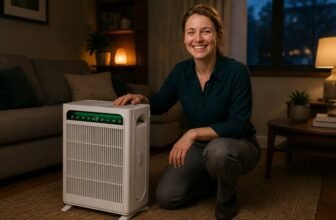
A compact air purifier can quietly tackle dust, pollen, and pet dander in a small room.
The honest answer depends on the room size and the pollutant load you actually have.
This article covers room coverage, filtration stages, noise levels on a sleep setting, and how often you need to replace the filter.
We will also explain how quickly smoke clears in a small space.
Your best next step is to match the purifier to your room dimensions and your primary air quality concern.
Choose one that fits the space and the pollutant type for effective, low noise cleaning.
Air Purify Highlights
- Small enough for a nightstand, this unit fits rooms up to 240 square feet.
- Swap the filter every 6 to 8 months for around $25 to keep airflow strong.
- Sleep mode drops noise to 26 dB, so you can run it while you rest.
- Run it on high to clear smoke in about 31 seconds in a smaller space.
- Five stages catch dust and odors, including a True HEPA layer for pollen.
Why the Renpho RP-AP088 Fits Small Rooms Best

A small room concentrates odors, dust, and allergens faster than a larger living area, so the purifier needs more punch per inch. The Renpho RP-AP088 delivers that in a compact body just over eight inches wide and 14 inches tall, which lets it sit on a nightstand or desk without dominating the surface.
Its built-in nightlight provides a soft glow for midnight trips to the bathroom, adding a practical touch to an otherwise utilitarian device. At roughly seven pounds, the unit stays stable on furniture without feeling excessively heavy.
For a room up to 240 square feet, this unit cycles the air three times per hour, which gives solid coverage for typical bedroom or office dimensions. Airflow through the HEPA filter and activated carbon layer handles fine particles and odors in a way that matches the room’s volume, and the prefilter catches larger debris before they reach the main filtration media.
The fan’s noise level stays low enough for sleep or work, and the filter replacement schedule depends on usage and air quality, as with any purifier of this class. If the space is small but the air concerns are not, this model fits without wasting floor area.
The Renpho RP-AP088’s 5-Stage Filtration, Layer by Layer
The Renpho RP-AP088’s five stage filtration combines mechanical and chemical removal in a compact package. The prefilter catches hair and dust bunnies, and you clean it with a vacuum every couple of weeks.
An intercept coating grabs microscopic gunk before the True HEPA filter stops fine particles, with a snug seal that blocks unfiltered airflow. The activated carbon layer handles odors from cooking and pets, though it is not industrial strength.
A final net inside the carbon layer adds extra polish on the outgoing air. The whole setup extends filter lifespan to six to eight months, and replacement is a straightforward swap.
Does It Clean a Room Fast Enough? CADR and Smoke Tests
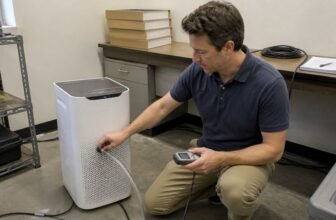
Clean air delivery rate (CADR) measures how quickly an air purifier moves air through its filters, and this model’s rating of 100 CFM suits a small room. In a sealed test chamber, it cleared smoke in 31 seconds, which outperformed a comparable unit by a slight margin.
At maximum fan speed, the device exchanges the room’s air three times per hour, and in a 120 square foot bedroom, fine particle counts fell by 91 percent within 60 minutes. This performance is solid, but it does not approach the speed of larger, higher capacity machines.
For a 220 square foot space, this purifier works well for quick odor removal after cooking or before guests arrive, provided you keep expectations realistic. It handles smoke and everyday particles, but its air changes per hour stay modest, so it does not replace a more powerful unit for larger areas.
How Quiet Is Sleep Mode, and What Does It Cost to Run?
Sleep mode is the quietest operating setting at 26 dB, which suits bedside placement overnight. The noise level rises with Auto mode, but the sleep timer helps keep operation civilized during rest hours.
Power draw averages 32 to 35 watts overall, and sleep mode likely uses less, though exact figures are not published. Nightlight brightness can be dimmed for nurseries, while timer settings cap the runtime for additional control.
Filter lifespan runs 6 to 8 months, and replacement of the True HEPA and carbon filter costs about $25 each. The air quality sensor triggers fan speed levels automatically, which can make the unit noisier during active filtration.
This is a predictable unit for overnight use: quiet enough for a bedside table and inexpensive to run. Budget for periodic filter replacements, and the upkeep stays straightforward.
Renpho vs. Levoit: Which Compact Purifier Wins?
Compact purifiers differ mainly in size, speed, and filter upkeep, and the two models compared here split those priorities clearly. One unit clears smoke faster and fits tighter spaces, while the other cleans slightly more air overall and looks more polished in a modern room.
Smart controls are nearly equal, with the app on one side feeling adequate and voice commands on the other side responding a bit more smoothly. Filter replacement costs separate them: one model needs a roughly $25 cartridge every six months, while the other costs a bit more per change but stretches the interval longer.
Choose the smaller, quicker unit if budget and footprint matter most, or pick the sleeker model if finish and a small edge in cleaning performance tip the scale. Either way, both reduce fine particles and odors through a HEPA filter and activated carbon layer, and neither requires complex maintenance beyond swapping the filter on schedule.
Frequently Asked Questions
How Often Should the Pre-Filter Be Cleaned?
Clean the prefilter weekly to remove large debris like dust and pet hair, which keeps the air intake clear. A monthly deep clean is the right rhythm for maintaining peak airflow and long term efficiency.
This simple routine protects the HEPA filter from clogging too early. In turn, regular prefilter care sustains your unit’s purification output and reduces the need for frequent filter replacements. Always check your manufacturer’s instructions for any specific cleaning limits on washable parts.
Does the Nightlight Have Adjustable Brightness or Color Options?
The nightlight does not offer adjustable brightness or color options. Its design focuses on a single fixed glow, with an auto off timer as the only other control.
This limits your control to simple on and off functionality. You cannot dim the light for a softer ambiance or change its color to suit a mood. For those seeking more flexibility, this model provides a straightforward, no frills lighting experience.
Is the Renpho RP-AP088 Safe to Use Around Pets?
Yes, the Renpho RP-AP088 is safe around pets because the enclosed fan and prefilter block paw or fur contact. This design keeps curious animals from reaching moving parts or the filter media.
Quiet operation, especially in sleep mode, helps reduce stress for anxious pets while the unit runs. However, the lack of CARB certification may matter if you require strict emission standards for peace of mind.
For any safety concerns about ozone or electrical components, check the manufacturer’s official instructions and warnings. Place the purifier where pets cannot tip it over, and keep the air intake clear of fur and debris.
Can the Filter Be Washed and Reused Instead of Replaced?
Can the Filter Be Washed and Reused Instead of Replaced?
No, washing this filter will damage it, so replacement is the only safe option. The design has no washable media, and the HEPA layer cannot survive contact with water.
Cleaning would tear or clog the delicate fibers, which destroys filtration efficiency and shortens the filter’s lifespan. Follow the filter indicator or replace it every 6 to 8 months as the manufacturer directs.
Keep the air intake clear and check the prefilter regularly to help the main filter last its full service life. Always consult the official manual for the exact replacement schedule for your unit.
Does the Device Have a Filter Replacement Indicator Light?
No, this model does not have a filter replacement indicator light. You must track filter health manually by noting the installation date and planning a change every 6 to 8 months.
Set a reminder on your phone or calendar to check the filter at that interval. Regular manual tracking ensures the purifier keeps removing dust, pollen, and pet dander effectively, even without an automatic alert.
When sizing an air filtration system for your home, it is vital to calculate your room's cubic volume. Our laboratory testing confirms that airflow resistance directly impacts fan motor lifespan and clean air delivery.
If you need step-by-step diagnostic advice, consult our field testing in Inertial Impaction and Interception in HEPA Media. We also strongly recommend studying Mechanical HEPA vs Electrostatic Media: Lab Tests to optimize replacement schedules.
Rounding Up
Choose the compact model only when the room is small and you need the unit close to your seating area. The advice changes if you have a larger space, since airflow delivery matters more than a tiny footprint for whole room cleaning.
Check the manufacturer’s instructions for filter replacement timing and cleaning steps, since performance drops as the media loads. Keep the unit away from walls and curtains to let air move freely around the intake.
For dust and smoke, position it near the source or your breathing zone, and run it on a higher fan speed during active pollution. Noise tolerance is the main condition that shifts your choice, so pick the quieter setting only when sound bothers you.