Wondering if a HEPA filter can capture airborne viruses in your living room? Yes, HEPA filters capture airborne viruses, but they trap them rather than destroy them.
The honest answer depends on keeping the filter dry and positioning it where air actually flows.
This article covers how these filters snag particles, why placement matters, and what to skip, like pricey coatings.
It also explains why running the unit continuously gives you the best results.
Choose an air purifier that fits your room size and the specific pollutants you want to address.
Air Purify Highlights
HEPA filters catch airborne viruses like SARS-CoV-2 at 99.97% efficiency for particles sized 0.3 microns.
Trapped viruses can stay infectious on the filter for hours or days, so handle disposal with care.
Keep indoor humidity between 40 and 50 percent because moisture weakens how well the filter works.
Place the filter near where people sit or sleep to get the best real world virus removal.
Airflow and fan strength matter more than filter size when trying to clean a room quickly.
Does HEPA Kill SARS-CoV-2 or Just Trap It?

HEPA filters capture SARS-CoV-2 particles by trapping them in their fibers, not by killing the virus. The trapped virus can remain infectious on the filter media for hours or days, depending on humidity and temperature, so the filter holds the hazard rather than eliminating it.
This creates a practical concern when you replace the filter. Wear gloves, place the used filter in a sealed bag, and wash your hands afterward, since disturbing the loaded filter can release the virus back into the air.
How HEPA Filters Trap Viruses: The Role of Particle Size?
A HEPA filter captures viruses by exploiting the physics of particle motion, not by acting as a simple sieve. Viral particles often travel inside droplets or dried nuclei that range from 0.1 to 10 micrometers, and the filter’s tangled fibers handle this size range through three distinct mechanisms.
Large particles collide with fibers by impaction because their momentum carries them into the mesh. Mid-sized particles are caught by interception when they follow the airflow and brush against a fiber surface.
Large particles slam into fibers by momentum; mid-sized ones brush against them mid-flow.
Tiny particles under 0.3 micrometers avoid the pores but get captured through diffusion, as random molecular jiggling increases their odds of touching a fiber. The most penetrating particle size sits near 0.15 to 0.3 micrometers, yet the filter still removes 99.97 percent of particles at that size.
The fan does essential work by pushing air through the dense filter medium, and real world tests show an 85 percent virus removal rate after one chamber volume of air passes through. Keep the air moving and the filter will handle the rest.
What Happens When Moisture and Droplets Meet a HEPA Filter?
Moisture in the air changes how a HEPA filter performs, and wet filter bypass becomes a real risk when liquid slips around the fibers instead of passing through them. Droplet wicking spreads that moisture across the media, turning a fine mesh into a soggy mess that loses efficiency just when you need it most.
Waterlogged media stops capturing particles, and condensed exhaust pushing out the back is a sign that the filter is saturated and airflow is compromised. Keep indoor humidity around 40 to 50 percent so the filter stays dry, since dry filters catch particles while wet ones fail to do their job.
Can a HEPA Filter Stop SARS-CoV-2 in a Real Home?
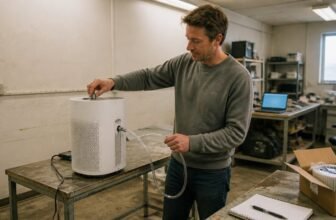
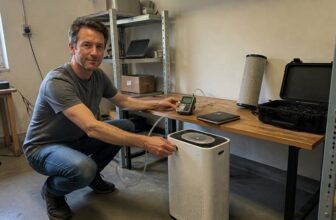
A portable HEPA purifier keeps the air near it clean, but it does not police every corner of a home. In a 100 hour field trial with two asymptomatic adults, the purifier’s inlet caught adenovirus while its outlet stayed virus free, proving that virus aerosols get trapped where airflow actually flows.
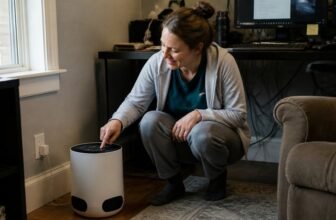
Household airflow is fickle, leaving dead zones where pathogens linger. Placement matters, so put the purifier near a bed or couch rather than in a random corner.
It is a local hero, not a whole house bouncer. Run it continuously, because stopping resets your gains.
Filters do not scrub surfaces or block your sneeze’s path. Use the purifier where you sit, not as a housewide shield.
Are Antiviral Coatings Worth Adding to HEPA Filters?
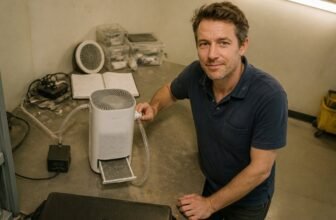
Antiviral copper coatings on HEPA filters provide only a marginal improvement in pathogen capture. In a five minute lab test, a copper based coating reached 90.35 percent removal compared to 85.38 percent for a standard filter, a difference that does not justify the added cost.
Moisture exposure undermines both coated and uncoated filters. When airflow is wet, even an absolute H14 filter lets SARS CoV 2 pass through, so coatings do not address the core weakness of damp conditions.
For a typical home environment, a standard HEPA unit performs adequately with dry air. Keep relative humidity low and replace the filter annually to maintain performance.
Skip the coated upgrade and spend the money on a second air purifier instead. This approach gives more airflow coverage for the same budget, while the coating remains a marketing feature rather than functional germ protection.
Frequently Asked Questions
How Often Should I Replace My HEPA Filter?
Replace your HEPA filter every 6 to 12 months, but your exact timing depends on your usage and environment. A home with heavy pollution, pets, or frequent high fan speed use will need a new filter closer to the 6 month mark.
Watch for three clear signs that your filter is full: louder fan noise, weaker airflow from the outlet, or a visible layer of dust on the filter media. If you notice any of these, change the filter sooner, even if the calendar says otherwise.
Follow the filter replacement indicator on your unit when it lights up, as it tracks real runtime, not just dates. For best results, check the manufacturer’s manual for your model’s specific interval and always install the replacement exactly as shown.
Do HEPA Filters Remove Viruses From Surfaces?
HEPA filters do not remove viruses from surfaces; they only capture airborne particles as air passes through them. Surface contamination remains a separate issue that requires cleaning or disinfection, not filtration.
This distinction matters for hygiene protocols because filtration targets suspended viruses, while surface transmission is a contact risk. Use HEPA filtration to reduce airborne virus levels, but rely on appropriate surface cleaning practices to address settled pathogens.
Can I Wash and Reuse a HEPA Filter?
Washing a HEPA filter is not recommended because water causes dampness damage that compromises its structure and encourages microbial growth. This moisture weakens the fibers, leading to rapid degradation and a much shorter lifespan.
A wet filter also loses its ability to capture viruses and particles effectively. Disposal and replacement are the only proper methods for maintaining performance. Check the manufacturer’s instructions for your specific filter replacement schedule. Never rinse a HEPA filter; simply swap it for a new one when the filter indicator signals it is time.
What Is the Ideal Room Size for a HEPA Purifier?
For most homes, choose a purifier whose stated room coverage matches the room’s square footage. That rating assumes average ceilings and a normal pollutant release rate, giving you effective filtration for daily life.
For larger spaces or high emission activities like cooking, you need a higher CADR or more than one unit. Match the device to the room’s volume, and run it continuously to maintain the target air changes per hour.
Do HEPA Filters Reduce Airborne Mold Spores Too?
Yes, HEPA filters capture airborne mold spores down to 0.3 microns, just like they trap dust and pollen. The filter works best when your HVAC system moves air steadily across it, so keep the fan running to pull spores out of your living space.
However, filtration alone does not stop mold growth. Spores settle on surfaces, and if moisture is present, they will multiply. Pair your filter with dehumidifiers or leak repairs to control humidity.
For maximum benefit, place the purifier in the room where mold problems appear, away from walls. Change the HEPA filter as the manufacturer directs, since a clogged filter reduces airflow and spore capture.
Rounding Up
Buy a true HEPA unit and run it continuously in the room where you spend the most time. That is the single most useful step for lowering airborne viral particles.
The advice changes if your room is very large, since a smaller unit will struggle to cycle the air quickly. Follow the manufacturer’s guidance on filter replacement and fan speed to keep performance steady.
For health concerns, talk to a doctor if symptoms persist, but the main condition remains consistent airflow. Keep doors closed and the unit running to maintain the benefit.