Wondering if that HEPA filter in your air purifier is actually enough for your home? The honest answer depends on the specific pollutants you are targeting, like dust, smoke, or pet allergens.
This article breaks down the strict testing standards for nuclear grade filters to show you what high level performance really means. You will learn how rigorous quality checks relate to the resistance, efficiency, and durability you might need.
Use this information to choose a purifier that matches your room size and main air quality concern.

Compact size fits small housings while capturing fine particles at high efficiency.

Large media area handles higher airflow with lower resistance for critical systems.

Gasketed edge helps maintain leak-tight seal during installation and testing.
Check discounted items inHEPA Filters
Air Purify Highlights
- All safety and habitability filters get full fan testing to catch any leaks before they ship.
- You can trust a filter only when its penetration stays below 0.03% at 0.3 micron particles.
- Filters rated 125 ACFM or higher also run at 20% airflow to check low speed performance.
- Watch the resistance limit, since it sits at 1.3 inches for standard units but drops to 1.0 for size 4 or 5.
- A failed test gets you a five working day heads up and a rejection label for proper disposal.
Why DOE-STD-3020 Dictates HEPA Filter QA
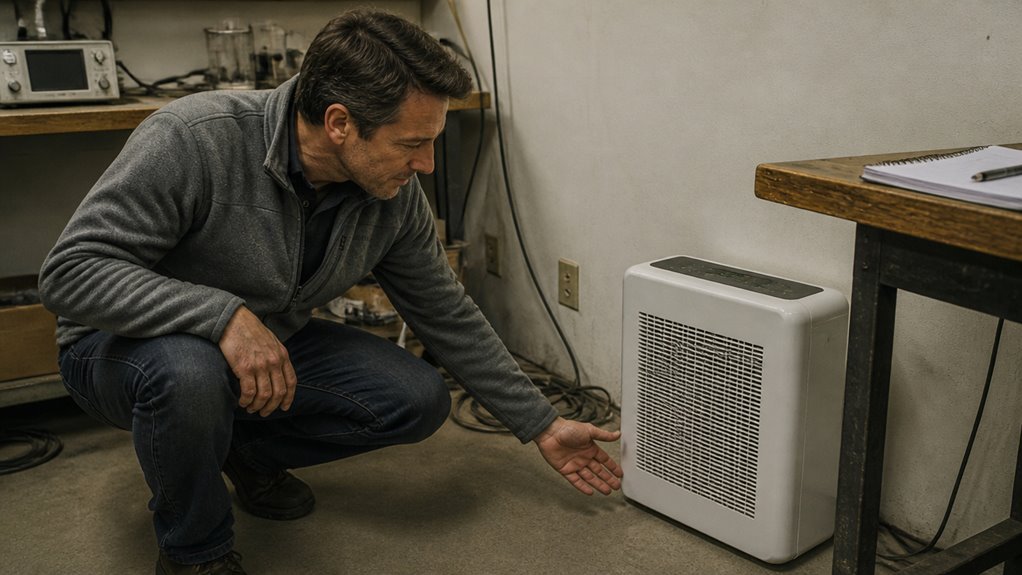
DOE-STD-3020 exists to stop nuclear facilities from treating HEPA filters as expensive glorified screen doors. Its quality assurance rules force real world stress testing, like exposure to fire induced thermal shock and violent pressure spikes, to prove the frame and gaskets hold up under these conditions, not just the filter paper.
Each unit must pass a 0.03 percent penetration test at rated airflow, which confirms the filter catches fine particles at the stated performance level. This requirement turns a supplier’s assurance into verifiable proof, and for nuclear safety that proof is the only acceptable basis for operation.
Which Filters Require 100% FTF Testing?
Which filters require 100% FTF testing depends on whether the facility’s safety depends on the filter. In DOE nuclear sites, every HEPA filter serving a Category 1 or 2 safety function, plus those in habitability systems, goes to a DOE Filter Test Facility without exception.
The FTF runs the aerosol penetration test and also performs visual inspections for shipping damage and manufacturing defects, after checking purchase order compliance. Filters for general ventilation that do not provide radiological confinement are exempt from this requirement.
Filters catching radioactive particulates that could harm workers or the public are the ones that receive the full treatment. For safety critical duty in a nuclear facility, 100% FTF testing is mandatory.
Manufacturer vs. FTF: How the Two-Tier Testing System Works
Two independent testing layers guard every nuclear grade HEPA filter. The manufacturer first runs its own production tests, recording penetration and resistance by serial number, and those results become part of the QA paperwork that follows each filter.
The DOE’s Filter Test Facility, or FTF, does not rely on that paperwork and retests every critical filter on its own. FTF staff begin with visual checks for shipping damage or construction flaws, then run the aerosol tests, and if a filter fails, they alert the site and manufacturer within five working days.
This split keeps both parties accountable, with the manufacturer vouching for its product and the FTF verifying the claim. That redundancy matters when your air depends on the filter working correctly.
Penetration Testing HEPA Filters: The 0.03% Limit and Dual Airflow Checks
Penetration testing enforces a maximum leak rate of 0.03% at 0.3 microns, meaning no more than three particles pass for every 10,000 challenged. Filters rated at 125 ACFM or higher undergo testing at both 100% and 20% of rated airflow.
The dual airflow check matters because leaks often appear at lower velocities, while precise aerosol sizing keeps results consistent. Poor particle generation ruins test reproducibility faster than a coffee spill on a calibration sheet.
Any filter exceeding the 0.03% cap is rejected, and the buyer receives written notice. Trust the dual airflow check, since a filter may perform well at full blast but fail when airflow slows.

Measures low-speed airflow to verify 20% rated flow checks and system balance.

Reads inches water gauge to confirm resistance stays within 1.3 or 1.0 limits.

Calculates volumetric flow to match filter size class and fan static pressure.
Browse discountedAirflow Measurement Instrumentson Amazon
Airflow Resistance Limits: 1.3 In WG vs. 1.0 In WG for Larger Filters
The airflow resistance limits in DOE-STD-3020 split between 1.3 inches water gauge for most filters and a stricter 1.0 inches water gauge for Size 4 (500 ACFM) and Size 5 (1000 ACFM) filters. That lower threshold for larger filters is a deliberate design choice, since bigger media beds can handle more flow with less backpressure, and it forces manufacturers to keep their pressure drop in check. When you are picking a filter, know your size class first, because the resistance spec is a hint about how the filter is built.
Resistance Thresholds Defined
Resistance limits in DOE STD 3020 follow a simple split. Most filters cap at 1.3 inches water gauge, while the larger Size 4 and Size 5 units, rated for 500 and 1000 ACFM, are held to a stricter 1.0 inch water gauge.
The lower threshold for bigger filters manages pressure drop under real test conditions, where larger face areas can mask uneven loading. A larger filter holds more contaminant but clogs faster at the core, similar to a bigger sponge.
For buyers, this means Size 4 and 5 units require more efficient media or pleat geometry to stay within the stricter cap. Most standard filters keep the familiar 1.3 inch ceiling, which simplifies retrofits for existing systems.
Check your filter’s size class before assuming the default limit applies. An incorrect assumption can lead to premature filter replacement and unexpected maintenance costs.
Rated Airflow Testing Rules
Larger filters get a stricter airflow limit because they move more air, so their internal resistance builds faster. DOE-STD-3020 caps Size 4 (500 ACFM) and Size 5 (1000 ACFM) at 1.0 inches water gauge instead of the usual 1.3 inches for smaller filters.
Rated airflow testing checks resistance at the filter’s full rated flow, and precise airflow measurement is required to confirm the filter stays within its limit. Smaller filters keep a 1.3 inch water gauge maximum because their lower flow leaves more margin, while bigger filters drop to 1.0 inch because doubling the air volume raises pressure drop quickly.
This stricter limit reflects physical reality rather than a penalty, since a filter moving twice as much air should not be pushed harder. Measure airflow carefully and follow the specification, and the filter will operate without choking.
Large Filter Exceptions
Large HEPA filters with ratings of 500 or 1000 ACFM face a lower maximum airflow resistance of 1.0 inch water gauge, compared to the 1.3 inch standard for smaller units. This reduction happens because a larger media surface area creates more drag as more air is pushed through the fine filter material.
Size 4 filters (500 ACFM) and Size 5 filters (1000 ACFM) are capped at 1.0 inch water gauge at rated flow, while smaller filters keep the standard 1.3 inch limit. Check your fan’s static pressure budget before ordering, since selecting a larger filter means planning for that tighter airflow constraint.
- Size 4 (500 ACFM): maximum 1.0 inch water gauge
- Size 5 (1000 ACFM): maximum 1.0 inch water gauge
- Smaller filters: standard 1.3 inch water gauge
Knowing the size rating before you spec prevents airflow math problems during installation. The lower ceiling is a physical result of larger filters moving more air, not a design penalty.
What Happens When a Filter Fails FTF Testing?
When a HEPA filter fails FTF testing, the manufacturer must notify the site, the Office of Nuclear Safety (AU‑30), and the filter owner within five working days. This reporting window is a strict rule that keeps the process accountable and documents the failure without delay.
Failure Notification Protocol
A failure at the DOE Filter Test Facility starts a five working day notification clock. The standard requires immediate notice to the purchaser, AU 30, and the manufacturer, who coordinates root cause tracing.
The facility rejects the filter and marks it clearly for disposal. This formal process moves quickly so sites can respond without guesswork.
Fast failure communication keeps accountability clear from production to installation. Speed and clarity are the point of the protocol.
Five-Day Reporting Window
The five day reporting window begins when a filter fails at the DOE Filter Test Facility and runs for exactly 120 hours of working time. Those time bound alerts are a hard clock for everyone involved, not a polite suggestion.
The facility sends notifications to the site, the Office of Nuclear Safety, and the manufacturer through DOE coordination, which keeps the chain of custody clean. Failing filters receive a rejection label that marks them unfit for any nuclear air cleaning duty.
The pace is brisk but fair, since nobody wants a leaky HEPA filter lingering in limbo. When a test goes south, expect prompt action rather than wiggle room.
Reading FTF Labels and Serial Numbers for Compliance
Every filter that passes through the DOE Filter Test Facility carries a small label that links it to its test records. Label placement is standardized on the filter case side, so you can find it quickly without moving the unit.
The serial number is the key for traceability, connecting each filter to its test date, penetration percentage, airflow rating, and acceptance mark. Check the label, note the serial number, and keep records for audits.
- Test date: when the facility ran the quality check
- Penetration percentage: maximum aerosol leak measured
- Airflow rating: rated cubic feet per minute tested
- Acceptance mark: pass or fail verdict
- Serial number: full history link to test results
Without reading the label, you lose the link between the filter and its performance data. Your facility’s safety and audit readiness depend on this record keeping.

Detects 0.3 micron particles to verify penetration and leak performance.

Provides real-time counts for aerosol challenge and filter efficiency checks.

Tracks fine particle levels to confirm clean air after filter installation.
See today's best deals onParticle Counters
Frequently Asked Questions
Can Filters Be Shipped Directly to DOE Facilities Without FTF Testing?
No, filters cannot ship directly to DOE facilities without FTF testing. HEPA certification requires FTF quality assurance evaluation for qualifying filters, so shipping approval depends on prior test acceptance.
Coordinate with the facility’s receiving team to confirm their exact FTF documentation requirements. Logistics must wait until your filter batch passes the required evaluation, as this step is non negotiable for compliance.
What Qualifications Must an Independent Test Laboratory Hold?
An independent test laboratory must hold an accreditation scope that specifically covers HEPA filter standards, along with documented proficiency testing success. Accreditation confirms the lab meets recognized quality and technical requirements for this exact testing category.
Without this formal accreditation, any qualification claims are unverified and carry no weight for regulatory or purchasing decisions. Look for an accreditation body that is internationally recognized and verify the scope explicitly lists the relevant HEPA filter test methods before relying on any results.
Do FTF Exemptions Exist for Filters Below 20 ACFM?
No, FTF exemptions do not exist for filters below 20 ACFM. The standard requires full testing for every unit, no matter how small the airflow capacity. No low flow exemption or reduced testing scope applies to these smaller units.
This means a filter rated under 20 ACFM must meet the same performance verification as a larger system. Full compliance testing is mandatory across all capacities, so there is no path to skip or shorten the evaluation process based on size alone.
Are Filter Frames or Gaskets Replaced Before FTF Testing?
Frames and gaskets are not replaced before FTF testing; they are assessed exactly as received. This preserves the original condition as the baseline for evaluation.
Frame replacement only happens after a failure has been identified, not as a preventive step. Gasket integrity is checked visually, which prioritizes the component’s original state over any proactive substitution. Assessing components as received gives you the truest picture of current performance. Replacing parts only after failure keeps the process focused on actual issues, not assumed ones.
How Often Must Filter Models Be Re-Qualified per ASME AG-1?
Re qualification interval is not fixed; filter model aging necessitates periodic review per ASME AG-1, with re-qualification typically required upon design, material, or process changes, ensuring continued compliance with performance standards.
Re qualification frequency is not fixed under ASME AG-1. You must re qualify a filter model when its design, materials, or manufacturing process change.
Perform a periodic review to confirm the model still meets its required performance standard after aging.
This review keeps your system aligned with the code, but the code sets no single time limit for all filters.
Rounding Up
Choose the filter that shows a current serial number and a valid test record before you install it. That proof is the only way to confirm it meets the 0.03% penetration limit under the standard.
That advice changes if the unit is in a small room with low airflow, or if the filter is visibly damaged, which means replacement should happen sooner. For removal, cleaning, or disposal of a used filter, follow the manufacturer’s instructions and any local safety guidance.
If you have respiratory symptoms, ask a doctor before relying on the system. End with the serial number check as your final safeguard.