For most homes, H13 medical grade HEPA is more than enough for everyday dust, pollen, and pet allergens. However, H14 is the better choice if you live with heavy smoke or need true cleanroom level air, since it catches about ten times more particles during factory scans.
This article explains the real lab test differences between H13 and H14, focusing on MPPS efficiency and the stricter local leak limits for H14. It also clarifies why H14 can fail field retests, so you know to ask for the scan report. Just match the filter grade to your room size and main pollutant.
Air Purify Highlights
- Lab tests show H14 filters stop 99.995% of particles, while H13 stops 99.95%, so H14 is ten times better.
- Ask for the local leak limit, since H14’s 0.025% penetration is ten times stricter than H13’s 0.25%.
- A filter’s global average can hide pinhole leaks, so request a full scan of the filter media.
- Expect H14 to fail field retesting more often because its in situ leak threshold is 0.01%.
- Choose H14 if your cleanroom or home needs maximum protection against dust and smoke at the weakest filter spots.
H13 vs H14: Why Lab Results Diverge at MPPS
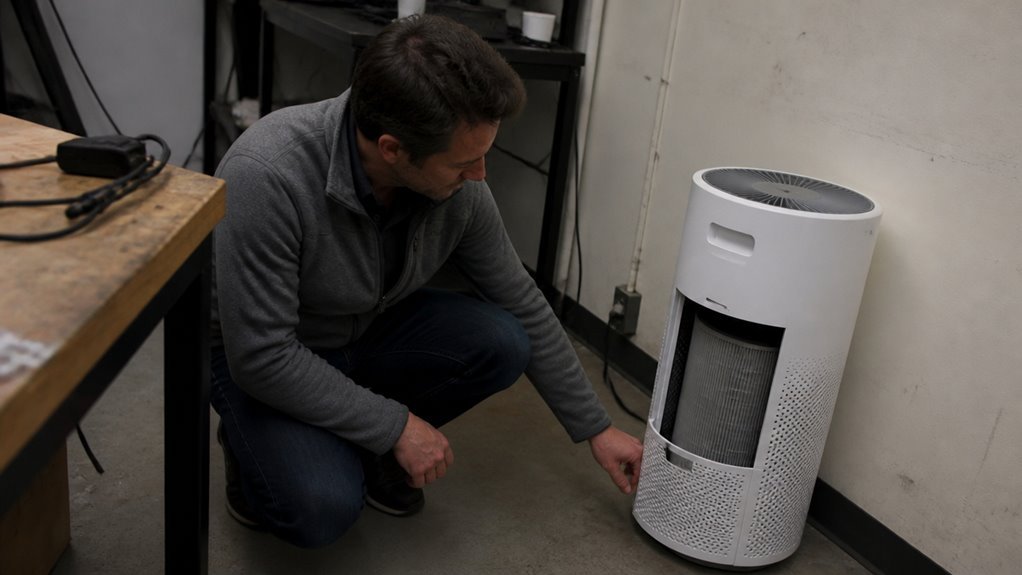
The performance gap between H13 and H14 appears only at the Most Penetrating Particle Size (MPPS), the 0.1 to 0.2 micron range where filters are least efficient. H13 captures 99.95% of those particles, while H14 captures 99.995%, which means ten times fewer particles slip through.
The distinction comes down to efficiency versus integrity. Efficiency measures the filter’s average performance across its entire surface, while integrity checks for a single leak that could ruin the overall result.
The real question isn’t the average, but whether one leak ruins the whole result.
A global average can hide a pinhole leak, so lab tests scan both metrics. Without integrity scanning, you would trust a pretty number over actual performance.
H14’s tighter local limits provide a real safety margin for applications that need it. The difference matters most in cleanrooms or medical settings where even a tiny breach is unacceptable.
What MPPS Testing Really Measures
MPPS testing measures the particle size where a HEPA filter is least efficient, typically 0.1 to 0.2 microns. This single efficiency number, per EN 1822-5, reflects the filter’s weakest point rather than its average performance.
During the test, a lab sends an MPPS test aerosol, usually PAO oil, upstream of the filter. An isokinetic probe must draw air at the same speed as the filter’s face velocity, since a mismatch skews the leak measurement.
The result is a global average efficiency, not a map of local flaws. That MPPS point separates H13’s 99.95% efficiency from H14’s 99.995%, which means a tenfold difference in particle penetration.
For air purifier buyers, trust that MPPS number as a baseline for filter grade. Scanning the filter surface reveals local defects later, but the MPPS value gives you a comparable starting point.
How Factory Scanning Separates H14 From H13
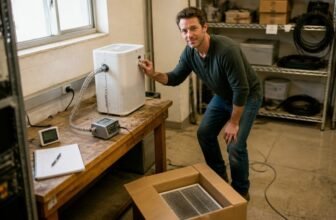
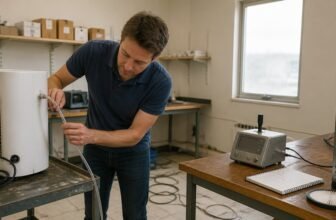
A single leak test matters more than the efficiency number on a spec sheet because a factory scan catches the tiny pinholes that average numbers hide. Every H13 and H14 filter gets a full filter mapping, where a probe sweeps the entire face, hunting for local penetration, which is a concentrated particle stream slipping through a defect.
The scan protocol uses isokinetic sampling, matching air velocity to avoid false readings, and leak detection is binary: pass or fail. H14’s local limit is 0.025%, ten times stricter than H13’s 0.25%, so a filter claiming 99.995% efficiency but failing its scan test gets rejected with no excuses.
That is why scan testing separates the two ratings, because it marks the difference between a lab number and a real leak free product. Always demand the scan report instead of relying only on the spec sheet, since the report verifies the filter’s actual integrity under a full face probe sweep.
H13 vs H14: Why Field Retesting Can Reject H14
A factory scan report only proves the filter was perfect on the day it left the lab. Field retesting checks the whole installed system, including the housing, gaskets, and frame, not just the media.
H14 often fails field retesting because the in situ leak threshold is stricter than the factory threshold. A small vibration during transport can shift a gasket and create a leak that exceeds the 0.01% limit, while H13 passes because its local tolerance is looser at 0.25%.
- Factory scan: both H13 and H14 pass easily.
- Field scan with minor gasket shift: H13 passes, H14 fails.
- Patch repair allowed: yes for H13 under limits, rarely for H14 because patch repair limits are tight.
- Replacement needed: often avoidable for H13, frequently required for H14.
Frequently Asked Questions
Can H13 Filters Pass as H14 With Lower Airflow?
Lower airflow does not turn an H13 filter into an H14. Reduced bypass and longer dwell time improve capture, but the filter media itself still caps efficiency below H14 at the most penetrating particle size.
Filter loading shifts performance over time, yet it cannot close the tenfold penetration gap between ratings. Certification requires H14 rated media, not airflow manipulation. For true H14 performance, choose a unit built with H14 grade filtration from the start.
Does Filter Aging Improve or Worsen MPPS Efficiency?
Filter aging improves MPPS efficiency only while particle loading has not yet shifted the most penetrating size. Once accumulated particles change that size, efficiency starts to drop, and heavy loading can collapse overall performance entirely.
Time is a double-edged sword for filtration because early aging can help, while later aging hurts. For best results, replace filters at the interval your manufacturer specifies. Watch for any drop in airflow or odor breakthrough, as those are clearer signals of aging than a calendar alone.
Why Do H14 Filters Fail Field Tests More Often?
H14 filters fail field tests more often because the most penetrating particle size shifts during real world operation and because sealing stress reveals micro leaks that factory scans miss. Local leak thresholds are usually far stricter than factory tolerances, so a filter that passes a clean bench test can fail once installed.
Installation stress and gasket compression change how the filter seats, exposing tiny gaps that laboratory scanning does not catch. The result is a filter that performs well in the lab but shows leakage in the field. For reliable results in place, ask the installer for on site leak testing after mounting, and check that the gasket surface is clean and undamaged before every replacement.
Are H13 and H14 Media Physically Different in Construction?
H13 and H14 media are not fundamentally different in construction because both use fine glass fibers. However, H14 rated media demands greater fiber density and higher resin loading to achieve lower particle penetration.
The physical makeup varies by manufacturing specification, not by an inherent material type change. Your filter’s performance depends on those density and resin choices during production, so H14 media is built tighter to capture more. This means the filtration efficiency difference is controlled by manufacturing tolerances, not by using a completely different material.
What Causes Local Leaks When Integral Efficiency Passes?
Whole filter tests average out performance, so a localized leak can hide behind strong overall efficiency. Damaged media or a failed seal in one spot lets bypass air slip through, even when the unit passes its overall rating.
Gasket compression set between the housing and frame is a common culprit. That creates tiny local paths around the filter, which you can catch with a scan test but not with an integral check.
For a real problem, focus on the seal and the media surface. Inspect the gasket for flat spots, replace damaged filter media, and run a targeted scan to find the exact leak path.
Rounding Up
Choose H13 for most homes and offices, since its real world performance is close enough to H14 at a lower cost. Pick H14 only when a room has strict cleanliness demands, like a clinical setting, and when the unit’s seals can be maintained perfectly. Leaky gaskets, not the filter media, often ruin an H14’s lab grade rating in practice. Follow the manufacturer’s instructions for installing and checking the filter seals, since a bad fit defeats the higher rating. Your main condition is seal integrity, so verify that before paying extra for the stricter grade.