
In a two story home, the stairwell acts as the main highway for air, moving heat, humidity, and pollutants between floors faster than any window. This means the air quality upstairs is directly tied to what is happening downstairs.
The honest answer to whether high ceilings affect this depends on the temperature difference between your floors, which creates a natural chimney effect. This article explains the airflow dynamics at play and how to manage drafts and condensation by sealing gaps and balancing pressure.
To address the root cause, match your air purifier to the room size and the specific pollutant you are targeting.
Air Purify Highlights
Stairwells act as the main vertical pipes that move heat, moisture, and pollutants between your floors.
Bigger temperature gaps between floors create stronger upward drafts through the stairwell.
You can slow the stack effect by sealing gaps around the stairwell and insulating the joists.
Use grilles or windows to balance air pressure and stop unwanted airflow between levels.
Standard computer models miss about 40% of the real airflow, so trust measured data for your design.
Why Stairwells Are the Main Highway for Air in Two-Story Homes
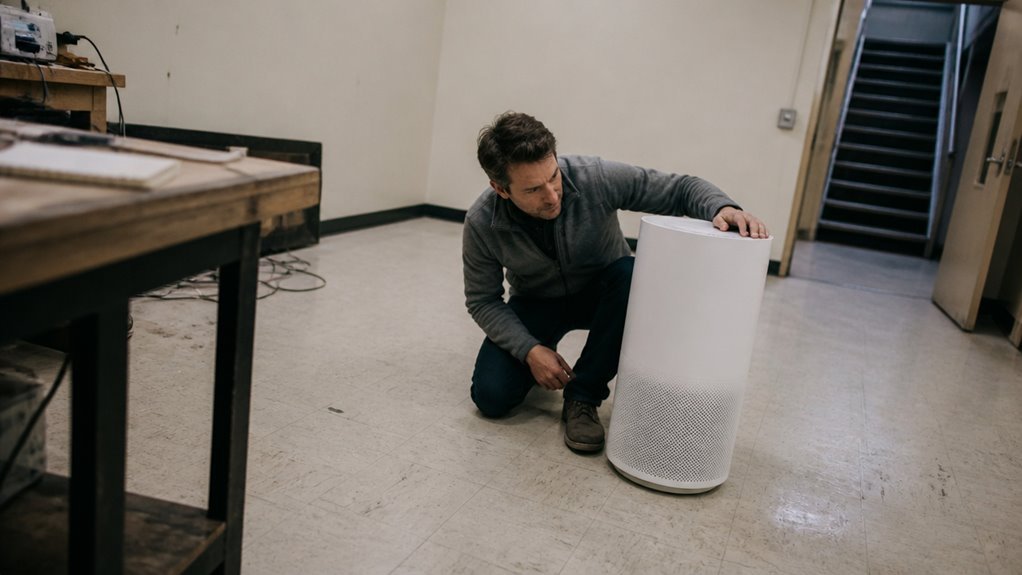
In a two-story home, the stairwell is the main highway for air moving between floors. This open vertical shaft carries heat, humidity, and pollutants far more effectively than door gaps or leaky windows.
In a typical Athens residence, measured airflow through the stairwell reached 0.170 m³/s with only a 6.2°C temperature difference between floors. That volume of moving air can redistribute fine particles, odors, and moisture throughout the house within minutes.
“Measured stairwell airflow hit 0.170 m³/s with just a 6.2°C gap—enough to spread pollutants house-wide in minutes.”
This airflow depends on complex mixing, not simple upward drift. Warm air rises, but it swirls and recirculates as it interacts with room geometry, creating behavior that shifts continuously.
Predicting these flows is difficult, and CFD simulations often fail to match real conditions without calibration. For a homeowner, treating the stairwell like a furnace duct helps control dampness and temperature upstairs before they become problems.
How Temperature Differences Drive Airflow Through Your Stairwell
Temperature differences drive airflow through your stairwell by making warm air rise and pulling cooler air upward behind it. A mere 0.2°C gap produces 0.039 m³/s of movement, while 6.2°C yields 0.170 m³/s.
If your upstairs feels stuffy, check the temperature gap between floors and increase it if possible. Stronger currents follow a bigger delta without any fan or air purifier help.
This buoyancy effect shifts the stairwell pressure as warm air escapes above and cooler air enters below. The result is measurable airflow that can move a small room’s volume in minutes.
For an air purifier, this natural circulation affects how well filtered air mixes across levels. Place the unit where it can capture the rising airflow, rather than fighting it.
Opening Size and Ceiling Height: Key Variables in Stairwell Airflow
Opening size directly controls how much air moves through a stairwell, and larger gaps produce a stronger, more consistent draft. A 1.19 m by 0.91 m opening pushes up to 0.170 m³/s at a 6.2°C temperature difference, while a smaller 0.101 m³/s flow occurs at 2.7°C.
Ceiling height sets the driving force by creating a taller buoyancy column, which increases the pressure difference that pulls air upward. A 6.3 meter stairwell amplifies that pressure, but the advantage fades if the opening is too small to let the air through.
Pair a generous opening with a full height stairwell to get a steady draft instead of a weak trickle. Skimp on either variable, and the airflow slows noticeably, a result you can feel as a cold layer near the floor.
Opening Size Effects
Stairwell opening size controls natural airflow between floors, and larger openings move more air at the same temperature difference. In testing, a 1.19 m × 0.91 m opening delivered 0.170 m³/s at a temperature difference of 6.2°C, while a smaller opening produced 0.101 m³/s at 2.7°C.
CFD validation using the realizable k‑ε model matched measured flows within 8.5% error. For builders, enlarging the stairwell opening is a more reliable way to boost ventilation than trying to increase the temperature difference between floors.
- Larger opening: 0.170 m³/s at ΔT 6.2°C
- Larger opening: 0.070 m³/s at ΔT 0.5°C
- Smaller opening: 0.101 m³/s at ΔT 2.7°C
Ceiling Height Impacts
Ceiling height changes stairwell airflow more than most homeowners expect, and taller ceilings stretch the buoyancy driven column to raise flow rates at the same temperature gap. A 6.3 meter ceiling in the Athens test home produced 0.170 m³/s at a 6.2°C delta, but that vertical gain complicates ceiling storage access and forces ladders or winches for attic gear.
The k-ε realizable model matched mixed convection within 8.5% under test conditions, yet real homes show less predictable results because of variable insulation and leakage. If you want a dramatic stairwell ceiling, plan for taller risers and stronger thermals, then measure the stack effect and check your upper floor duct balance before renovating.
What the Experiments Show About Your Stairwell
Stairwell airflow data from tracer gas decay experiments reveals how temperature differences drive air movement. Flow rates ranged from 0.039 to 0.170 m³/s across temperature gaps of 0.2 to 6.2°C, with larger temperature differences pulling more air upward.
Computer models used to predict this airflow produced inconsistent results. The k-ε realizable model matched mixed convection measurements within 8.5% error, while the standard k-ε model underpredicted natural convection by nearly 40%.
This means your stairwell behaves like an unpredictable chimney, especially when heat sources dominate the space. For indoor air quality work, rely on measured airflow data rather than model estimates when planning ventilation or air purifier placement, since uneven upstairs temperatures are likely under these conditions.
The Hidden Cost of Buoyancy: Moisture and Cold Upstairs Rooms
Buoyancy driven airflow through the stairwell does more than shuffle warm air; it carries moisture upward, raising condensation risks in upper bedrooms. Measured flow rates, often below 0.1 m³/s for small temperature differences, explain why upstairs rooms stay stubbornly cool even when the lower floor feels toasty.
This twin burden, dampness and insufficient heating, is the hidden cost of letting physics run your two story home. Both issues will affect how an air purifier with a clean air delivery rate performs, because cooler, moister air upstairs can reduce perceived comfort and increase the workload for any heating system.
Moisture Migration Risks
Stairwells in two story homes move humid air upward, and that moisture condenses on cooler upstairs surfaces like windows and walls. This condensation invites mold growth, so controlling airflow is the main defense.
A stairwell with a 6.3 meter height moves up to 0.17 m³/s when the temperature difference is 6.2°C, relocating damp air from kitchens and showers every night. Install a smart exhaust fan with a humidity sensor, seal stairwell gaps, and run a dehumidifier upstairs in winter to limit that upward drift.
- Install a smart exhaust fan with a humidity sensor.
- Seal stairwell gaps to block air leakage.
- Use a dehumidifier upstairs, especially in winter.
Buoyancy carries moisture regardless of wall finish, so managing the upward movement costs less than repairing wet drywall. Vent low, monitor high, and keep the upstairs air dry to avoid condensation problems.
Upstairs Heating Shortfalls
The same buoyancy that carries damp air upstairs also leaves upper rooms short of heat. Warm air rises through the stairwell and escapes, while the thermostat, usually mounted on the lower floor, never registers the chill above.
That misplaced sensor keeps the furnace running below, wasting energy and leaving bedrooms cold. Upstairs heat loss is not just discomfort; it is a predictable result of air movement.
Four common factors drive the problem. The stack effect pulls warm air up and out, bypassing bedrooms.
Thermostat placement on the lower floor ignores the cold upstairs. Weak airflow through doorways stalls heat exchange, and high ceilings trap warm air above head height, where it does no good.
Zone dampers or a second thermostat can redirect airflow and balance temperatures between floors. With those controls, your upper floor gets the heat it needs without overworking the furnace below.
How to Stop Stairwell Drafts and Condensation Risks
In a two story home, the stairwell acts like an unintended chimney, carrying warm, humid air upward where it condenses on cold upstairs walls. This stack effect creates drafts and dampness that can be corrected with three targeted steps.
Air sealing is the first move. Caulk gaps around the stairwell frame, which stops a meaningful share of air leakage, and add foam board insulation to exposed joists to eliminate cold spots that trigger condensation.
Pressure balancing is the second move. Open a window upstairs or install a small transfer grille to equalize air pressure between floors, which reduces the upward flow of moist air.
Seal, insulate, and balance all three together. Doing only one or two leaves the stack effect partially active, so you are still letting conditioned air escape and moisture collect on cold surfaces.
Frequently Asked Questions
Can Stairwell Airflow Spread Cooking Smells Between Floors Rapidly?
Yes, stairwell airflow can spread cooking smells between floors quickly. Warm air from cooking rises and creates a natural upward draft that carries odors along the stairwell. Air pressure differences between floors and convective loops actively pull that air upward, so your kitchen smell can reach other levels in minutes. To limit this, keep the stairwell door closed while cooking. Running your kitchen exhaust fan helps remove odors before they enter the stairwell, and a HEPA purifier with activated carbon near the kitchen can capture smell particles and gases.
Do Ceiling Fans Upstairs Disrupt Natural Stairwell Airflow Patterns?
Yes, ceiling fans can disrupt natural stairwell airflow, but the effect depends on fan speed and blade pitch. The fan’s vortex mixing overrides buoyancy driven flow, which weakens the temperature difference that normally pulls air upward.
Higher speeds create draft blocking, so the stairwell’s natural exchange becomes unpredictable. This can redirect dampness toward upper rooms, but the outcome varies with fan placement and house layout.
Use the lowest fan speed to preserve ventilation and monitor humidity upstairs. If dampness appears, operate the fan intermittently or adjust its direction to support, not fight, the thermal current.
Will Closing Upstairs Doors Reduce Moisture Transfer From Lower Floor?
Closing upstairs doors reduces moisture transfer by slowing stairwell airflow, but it does not stop it completely.
Gaps around doors and common construction leaks still allow humid air to drift upward, so the stack effect continues to work.
The key is to seal door bottoms and frames with weatherstripping to tighten the air barrier.
Even then, a humidity gradient remains, so upward movement persists through any remaining openings.
You will cut the transfer noticeably, yet you will not eliminate it unless you also address other air leaks in the floor and ceiling.
Use a dehumidifier on the lower floor to lower the driving force, and keep upstairs vents open for balanced pressure.
How Does Outdoor Wind Pressure Affect Stairwell-Driven Air Exchange?
Outdoor wind pressure can easily overpower the natural buoyancy that drives airflow in a stairwell. This means strong winds may reverse the stack effect, pushing air in the opposite direction than temperature alone would dictate.
The direction and speed of the wind will frequently determine whether air moves up or down the stairwell, regardless of how warm or cool it is inside. As a result, the airflow you measure in a stairwell reflects the outdoor wind conditions just as much as the indoor temperature.
This is why a building can feel drafty or stuffy even when the heating or cooling system is working correctly. If you are trying to understand air exchange in your building, check the local wind forecast along with the indoor to outdoor temperature difference.
Does Adding a Stairwell Door Increase Upstairs Heating Efficiency Significantly?
Yes, a stairwell door can significantly improve upstairs heating by reducing the stack effect and thermal stratification. It limits buoyancy driven airflow, which stops warm air from escaping upward and getting trapped near the ceiling.
This creates a more uniform temperature in your upper living spaces, so your heating system works less to compensate for cold spots. For best results, keep the door closed during heating season and seal any gaps around the frame to prevent drafts.
The main benefit comes from cutting off the vertical air column, not from the door itself blocking heat. If your upstairs still feels uneven after closing it, check your vents and insulation before assuming the door alone solves the problem.
Rounding Up
Place your air purifier near the stairwell opening to capture the strongest upward airflow. This works well when your pollutant source is on the lower floor and the unit has a high clean air delivery rate.
If your home has a closed door or a hallway blocking the stairwell current, move the purifier into the main living space instead. Room size and ceiling height also matter, so match the unit’s coverage to the square footage you are treating.
For filter cleaning or replacement, always follow the manufacturer’s instructions to avoid damage. If you have respiratory symptoms, consult a doctor rather than relying on the device alone. Keep the purifier running continuously, and adjust placement only when airflow changes.



