
If you are looking for an air purifier that can handle household odors and chemical pollutants like formaldehyde, the filter media inside matters more than you might think. Heavier carbon filters generally offer more surface area to trap these gases, though their lifespan still depends on your specific environment.
This article explains why a larger amount of granular carbon improves odor removal, and how a V shaped design increases air contact. We will also break down how adding a secondary oxidizing agent helps tackle different types of fumes.
When choosing a system, simply match the filter weight to the size of your room and the pollutants you want to address.
Air Purify Highlights
- A five pound carbon refill soaks up more odors than a half weight refill because it has more surface area.
- Bituminous coal carbon grabs a wider range of household VOCs than coconut shell due to better pore fit.
- You can stretch the filter’s two year life by keeping humidity low and avoiding heavy daily pollution.
- The V shaped media bed doubles airflow contact, so gases slow down and stick to the carbon longer.
- Potassium permanganate mixed into the carbon handles oxidation, but it does not replace lab grade ammonia removal.
5 Pounds of Granular Carbon: Why Weight Matters in the V5-Cell
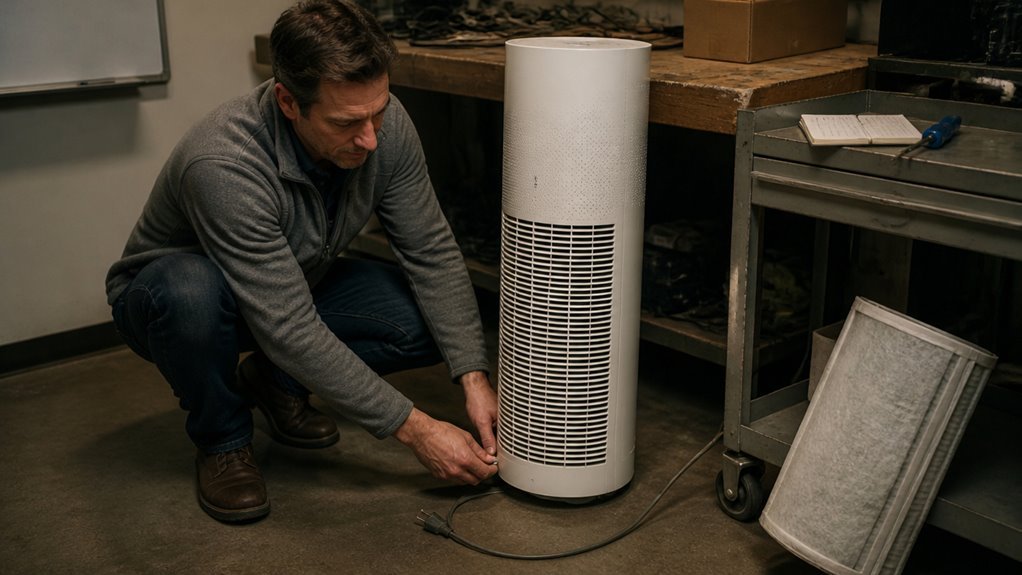
Five pounds of granular activated carbon provides more adsorbent surface than typical refills that pack half that weight into their frames. Heavier carbon mass means more pore volume for trapping gases like formaldehyde and smoke, which is why weight directly determines odor removal capacity.
Bituminous coal based carbon captures a wider range of volatile organic compounds than coconut shell alternatives, because coal’s pore structure better fits small gas molecules. This filter holds roughly 2.3 kilograms of adsorbent, so at moderate fan speeds it can serve for about two years before replacement.
A dense carbon block acts like a thick sponge, pulling contaminants into its interior rather than just coating the surface. You pay for adsorbent mass, and that mass performs the filtration work without any special effect beyond basic physical adsorption.
V-Shaped Dual-Stage Design: Adsorption Boost vs. Flat Filters
The V shape improves adsorption by directing air through two angled media beds, increasing surface contact without adding more carbon to the frame. Flat filters let air rush through the center while the edges go unused, but the V shape slows that airflow and gives gases more time to stick to the media.
This geometry provides more active surface area in the same footprint and distributes incoming air evenly across both media layers. It reduces dead zones where flat filters waste activated carbon, and it keeps channel velocity low for deeper gas penetration.
The design also maintains a lower pressure drop than thick, single block filters, so your fan moves air efficiently. For odor removal, this geometry outperforms flat filter packs.
- More active surface area in the same footprint
- Even distribution of incoming air across both media layers
- Fewer dead zones where flat filters waste carbon
- Lower channel velocity for deeper gas penetration
- Lower pressure drop than thick, single block designs
V5-Cell MultiGas Blend: What It Removes and Misses
The V5 Cell MultiGas blend splits its media evenly between activated carbon and potassium permanganate pellets, so each half handles a different job. Carbon adsorbs volatile organic compounds and odors, while permanganate oxidizes gases like formaldehyde and hydrogen sulfide, destroying them rather than merely holding them.
Media variants show the trade offs clearly. The pure VOC version uses 2.3 kg of carbon for heavy solvent fumes, and ChemiSorber leans fully into oxidation, but the MultiGas balances both functions.
This blend misses heavier industrial gases such as ammonia, which requires specialized media. It suits homes with mixed cooking, cleaning, or pet odors, yet it will not act as a lab grade scrubber.
Broad spectrum defense comes at the cost of deep specialization. For most living rooms this filter works well, but a chemistry bench demands a different approach.
V5-Cell Filter Life: 2-Year Average vs. Real Conditions
The two year lifespan on the box is an average, not a guarantee. The carbon bed’s rating assumes ten hours of daily use on speed three with steady, moderate pollution.
Real homes break that assumption. Heavy cooking, pets, or wildfire smoke can exhaust the filter in eighteen months, while a clean, low use space might stretch it past thirty.
Air changes per hour matter. A tight house with minimal ventilation loads the filter faster.
High humidity has a sneaky effect. Dampness clogs the micropores in activated carbon, cutting its adsorption capacity.
The two year figure ignores seasonal spikes. Paint fumes or off gassing from new furniture add a sudden pollutant load that the average does not capture.
Chemisorbant pellets degrade faster than plain carbon when tackling sulfur or formaldehyde hot spots. The filter’s runtime indicator only tracks hours of operation, not actual saturation, so it is a flawed proxy for remaining life.
- Replace the filter if odors return before the two year mark.
- Consider the filter’s condition a practical estimate, not a fixed deadline.
Frequently Asked Questions
Can I Recycle the Spent V5-Cell Filter Media?
Spent V5-Cell media cannot be recycled conventionally. The adsorbed contaminants and potassium permanganate classify it as toxic waste, so it requires hazardous disposal.
Check your local regulations for spent carbon disposal. Do not place it in municipal recycling streams because the chemical residue is unsafe. Contact your waste authority for the correct handling path.
Does the V5-Cell Work in High-Humidity Basements?
Yes. The V5-Cell works in high-humidity basements, but its performance drops as moisture levels rise. Saturated air speeds up adsorbent exhaustion, which shortens the carbon’s lifespan and allows contaminants to break through sooner.
Consistent dampness forces more frequent replacements than the usual two year interval. Watch for musty odors or reduced odor removal as signs that the media is spent. Keep airflow unobstructed and monitor humidity to slow degradation. For health or safety concerns about mold, follow the manufacturer’s guidance and consult a qualified clinician.
Are Replacement Filters Cheaper When Bought in Bulk?
Bulk buying triggers wholesale carbon savings, yet the per filter price flattens out once you reach a certain volume. Market data shows only modest discounts for single model orders, not dramatic drops.
Your real savings come from negotiating with distributors, not from sheer quantity alone. For most homeowners, the break even point appears quickly, so compare total cost against your actual replacement schedule.
Focus on your filter’s rated lifespan and your home’s usage pattern. That tells you whether bulk purchase truly pays off for your specific setup.
How Does the V5-Cell Handle Pet Dander Odors?
The V5-Cell uses activated carbon chemistry to tackle pet odors, which are gaseous molecules rather than dander particles. Its granular media excels at adsorbing odor molecules like ammonia and volatile compounds.
Physical pet dander requires a separate prefilter to be captured from the air. Performance depends on your airflow rate and the concentration of odors in the room, so results vary with your specific setup.
Will Shipping Damage the Cardboard Filter Housing?
Shipping can crush cardboard, but standard transit handling rarely damages the filter housing. The structure is built to withstand normal box compression, so typical bumps and stacking are not a problem.
Extreme impacts from dropping or crushing during shipping could dent the cardboard, though this is uncommon. Inspect the outer box for visible damage before you open the unit. If the housing looks bent or torn, contact the manufacturer for guidance on safe use.
Rounding Up
Keep the filter active for the full two years only if your home stays free of cooking fumes, tobacco smoke, and pets. For most real world homes, plan to replace it around the 14 month mark to stay ahead of odor buildup.
Room size and ventilation change that timeline, since a larger basement or frequent open windows will exhaust the carbon faster. If you notice lingering smells before that mark, replace the filter sooner rather than later. Follow the manufacturer’s instructions for proper installation and disposal so you get the intended performance. Act on the odor, not the calendar, since carbon load depends on your daily habits.



