
New carpet smell is 4 phenylcyclohexene, a VOC from the adhesive backing, and the article title asks whether your air purifier can neutralize it.
The honest answer depends on the filter type, as only activated carbon media will adsorb this compound effectively.
This article explains why masking fails, how pre airing and airflow beat filtration alone, and why HEPA only units miss the mark.
Choose an air purifier matched to your room size and pollutant load for the best practical result.
Air Purify Highlights
Activated carbon filters trap 4-PCH and formaldehyde, while HEPA filters only catch particles.
Air out new carpets in a ventilated warehouse for 48 hours before you bring them home.
Open windows and run fans for at least three days after installation to speed up offgassing.
Sealing a room stops ventilation benefits, and chemical smells bounce back within hours.
Choose a certified low emission carpet, like the Green Label Plus, to avoid the smell entirely.
Why 4-PCH Causes New Carpet Odor (And Why It Lingers)
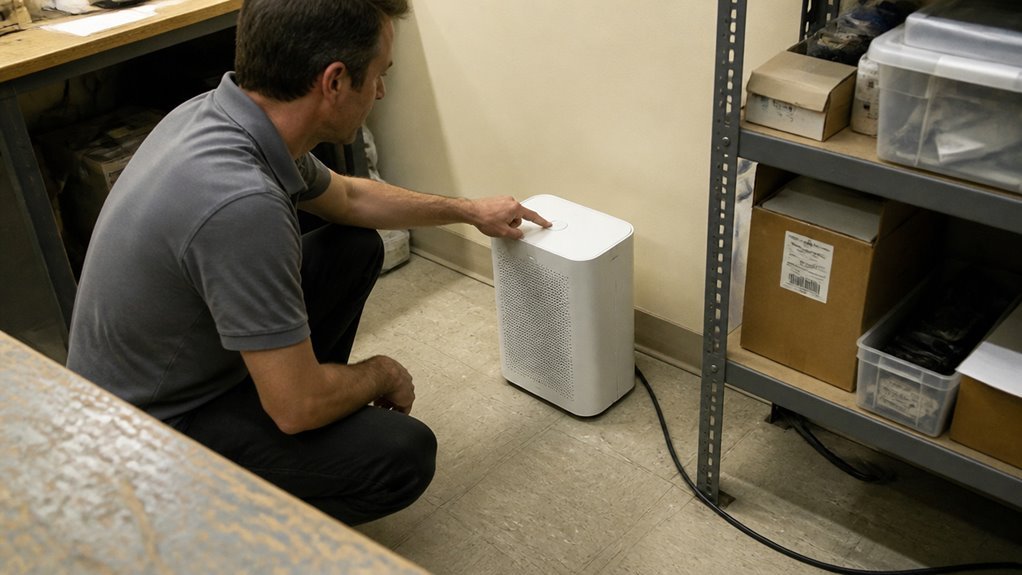
4 phenylcyclohexene, or 4 PCH, is the volatile organic compound behind “new carpet smell.” It is a byproduct of styrene butadiene latex, the adhesive in carpet backing, and your nose detects it at one part per billion.
The compound lingers because it decays slowly, with chamber tests showing concentrations drop by only half after weeks. Ventilation reduces levels while air moves, but the concentration returns when airflow stops, and sensory adaptation makes you think the smell is gone when your brain has simply tuned it out.
Air out carpet for two days before installation to cut exposure dramatically. That step is the most effective way to reduce the odor before it reaches your living space.
The Hidden Health Risk: Ozone Reactions and Formaldehyde
The interaction between 4-PCH and indoor ozone produces formaldehyde, a known irritant and probable carcinogen. Ozone enters homes from electronics, air purifiers, or outdoor air, turning a harmless new carpet smell into a measurable health risk.
You cannot see or smell formaldehyde at the low levels where it lingers, so the new carpet glow hides an active chemical reaction. Ventilation reduces the concentration, but it does not stop the formation once ozone is present.
- 4-PCH: source is carpet backing, health note is nose and throat tickle
- Ozone: source is electronics and outdoor air, health note is lung irritation
- Formaldehyde: source is the reaction product, health note is cancer concern
Treat the new carpet smell as a warning signal rather than a sign of freshness. An air purifier with activated carbon can adsorb 4-PCH and formaldehyde, while a HEPA filter handles particles but not gases, so check the filter type before relying on it for odor removal.
How to Reduce 4-PCH Before the Carpet Enters Your Home
The carpet’s fate is sealed weeks before it reaches your living room, and that is where the battle against 4-PCH is won or lost. Sourcing alternatives remains the sharpest weapon, because mills that pre-cure backing at high oven temperatures with forced air can cut outgassing by up to 80 percent.
Demand low emission certification such as CRI Green Label Plus, and ask for 4-PCH test reports, because you are paying for data rather than assurance. Specify latex frothing during backing production, since it traps residual styrene and reduces 4-PCH release before the roll ships.
Airing out the unrolled carpet in a dry, ventilated warehouse for 48 hours works well and costs little. This old school step is surprisingly effective, and it keeps volatile organic compounds from entering your indoor air during the first weeks after installation.
Choose a carpet that is already cured and aired, and you reduce the need for aggressive ventilation later. If 4-PCH levels still rise after installation, an air purifier with activated carbon can adsorb the remaining gas, while a HEPA filter captures fine particles that settle on the fibers.
Ventilation Alone Won’t Cut It: Why Concentrations Return Quickly
Ventilation alone only pauses the source of the odor, because the SBR latex backing in the carpet keeps releasing molecules at room temperature. Opening windows for three days drops 4-PCH concentrations, but levels rebound to baseline within hours once the home is sealed again.
Modern, energy efficient homes cannot sustain the dilution that fresh air provides, so the outgassing quickly reaccumulates. The effective fix is to air the carpet before installation, which slashes emissions dramatically before the material is laid.
Once the carpet is in place, you are left with a slow decay curve that a box fan cannot accelerate. Ventilating as needed gives temporary relief, but expect the odor to return after you shut the windows; pre air the material, rather than relying on post installation airflow.
Heat, Airflow, and Pre-Installation Airing: How to Speed Up Decay
Pre installation airing is the most effective way to cut peak exposure to 4 PCH, since unrolling fresh carpet in a warm, dry space for two days lets the strongest off gassing happen before the carpet enters your living area. Heat alone does little to speed decay unless airflow moves across the surface, so a fan aimed at the carpet makes a meaningful difference where a still warm room will not.
Mild baking inside a home gives mixed results, but pairing it with forced air ventilation shifts the outcome. Factory fresh carpet releases the largest share of volatile organic compounds in the first 48 hours, so airing before install captures that window when control is easiest.
After installation, keep windows open and fans running for at least three days to push the remaining odor out of the room. The practical sequence is to force early decay with heat and airflow, then maintain high ventilation after install, and the smell fades faster than if you let the carpet follow its own timeline.
Frequently Asked Questions
Can Houseplants Absorb 4-Pch From Indoor Air?
Yes, houseplants can absorb 4-PCH, though the scientific evidence is limited. Their natural metabolism allows some volatile organic compounds to be broken down, but the removal rate is far too slow for a typical living space.
Effectiveness depends heavily on the plant species, the concentration of 4-PCH, and room airflow. A few potted plants will not replace mechanical ventilation or an air cleaner. For reliable gas removal, use an air purifier with a substantial activated carbon layer. Keep the plant leaves dust free to maximize what little uptake they offer.
Do Air Purifiers Effectively Remove 4-Pch?
Do Air Purifiers Effectively Remove 4-Pch?
Air purifiers with activated carbon media can adsorb some 4-PCH, but effectiveness depends on having a large volume of carbon. The adsorption is temporary, so you must replace the carbon frequently to keep removing the gas.
Ozone generation is counterproductive, since it reacts with the air to create formaldehyde. Choose a purifier with no ozone emission and a high carbon content. Pair it with ventilation to dilute the pollutant. Replace the carbon media on schedule for any ongoing benefit.
Does Baking Soda Neutralize New Carpet Odor?
Does Baking Soda Neutralize New Carpet Odor?
No, it does not neutralize the odor chemically. Baking soda shows limited efficacy against 4-PCH, failing to break it down. Its sorption is inferior to activated charcoal alternatives or ozone treatment, so it offers only temporary, partial odor masking.
Ventilation remains the primary practical approach. For persistent new carpet smells, focus on increasing fresh air exchange first. Consider activated carbon for gas removal if airflow is limited. For health concerns, follow the carpet manufacturer’s instructions or consult a qualified clinician.
Are Certain Carpet Brands Lower in 4-Pch?
Yes, certain carpet brands are lower in 4 PCH, but you need independent verification before trusting a label. VOC testing methods, such as chamber emissions or CRI certification, reveal real differences between products.
San Diego carpet cleaners often spot low emitting options, yet no brand uniformly guarantees absence of this chemical. Ask the manufacturer for their latest test reports and confirm the carpet meets your indoor air quality goals before installation.
How Long Does New Carpet Smell Typically Last?
New carpet smell typically lasts for several weeks to months, though the intensity declines slowly over time. Ventilation only reduces concentrations while airflow is active, so its effect is temporary.
Health effects may include mild irritation, but prolonged exposure remains low. The primary odor compound, 4 PCH, decays very slowly, meaning the smell lingers. Activated carbon filters can help absorb these gases, but they work best with continuous airflow and regular filter replacement. Open windows and run fans to supplement odor removal between filtration cycles.
Rounding Up
Airing the carpet in a garage or covered outdoor space for several days before installation is the most effective first step for reducing the new carpet smell. This works best in warm, dry conditions with good airflow moving across the surface.
If you cannot air it out beforehand, use ventilation and a fan to increase air exchange during and after installation, but understand this is less effective. For any cleaning or maintenance of your ventilation equipment later, always follow the manufacturer’s instructions for safe operation.
Your best outcome depends on minimizing the odor source before it enters your living space. So plan for that pre installation airing period whenever possible.