
Air tests for black mold are clues, not verdicts, so treat spore capture results as one part of the indoor air quality picture. The honest answer depends on conditions: a single sample can miss mold bursts, especially in a quiet room.
This article explains why spore traps show only a snapshot and how airflow affects accuracy. You will learn to measure inhalation risk while confirming findings with surface wipes.
Know the limits to avoid false alarms or false security. Choose an air purifier that matches your room size and the specific pollutant you target.
Air Purify Highlights
- Spore traps miss surface mold and hidden wall cavity growth because they only catch what floats past at that moment.
- Stachybotrys stays quiet in calm air, so you need some airflow moving across surfaces before sampling for spores.
- A single room air sample detects black mold in under ten percent of affected rooms, so one test alone is weak evidence.
- Pair air testing with visual checks and surface wipes to see both inhalation risk and actual mold presence.
- Treat spore counts as rough ranges with up to double the error, never as exact numbers for decisions.
Can Black Mold Air Tests Give False Alarms?
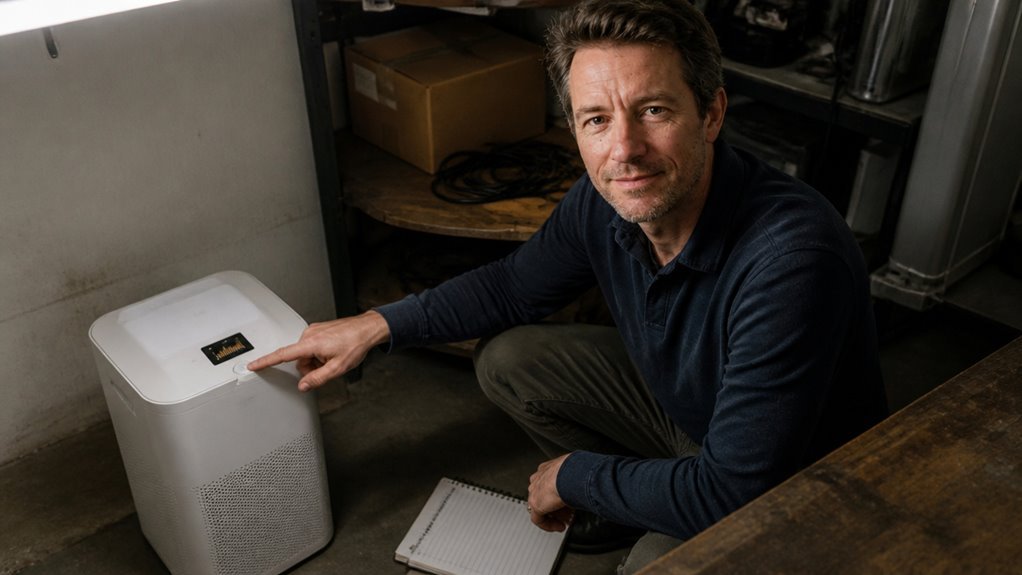
A positive mold air test result, such as 50 spores per cubic meter of Stachybotrys, signals a potential problem but does not confirm one. To interpret it correctly, compare the air sample against surface samples and a visual inspection, since a single reading can point to a real issue or a misleading decoy.
Treat the air test as one clue in a broader investigation, not as definitive proof. False positives are possible, so the combined evidence from surfaces and sight matters more than the number alone.
What the Houston Study Reveals About Mold Test Reliability
The Houston study shows that a single air sample often misses mold that is present, and the numbers prove it. In 200 water damaged homes, Stachybotrys mold was found using all collection methods 58.5% of the time, yet room air samples alone caught it in only 9.6% of those rooms.
Wall cavity spores had little effect once surface contamination was accounted for, and the real predictor was mold sitting on walls, not spores floating in the air. Spore release from surfaces, not hidden cavities, determines what you breathe, so a quick air test is like checking one slice of bread for mold.
Pair air testing with surface swabs to get a reliable picture, since a lone air sample can lead you to chase nonexistent problems. Treat air tests as a hint rather than a final answer, and take samples where dust settles, such as on shelves, floors, and window sills.
What Sampling Error and Airflow Do to Spore Counts
Spore counts from mold tests are far less precise than they appear, because sampling error alone can swing results by 30 to 200 percent. A reading of 500 spores per cubic meter might really be 300 or 700, so treat any single number as a broad range rather than a fixed value.
Airflow also controls when spores enter a sample, since mold like Stachybotrys tends to release spores only when air moves across it. A 10 minute sample taken on a quiet morning can miss a release that happens an hour later, so sample during active HVAC operation to capture more representative conditions.
Quantitative limits in lab analysis add another layer of uncertainty, because the counting math becomes unstable at very high or very low spore concentrations. Compare trends between repeated tests instead of relying on absolute values, since a shift from 900 to 300 across two samples tells you more than any single reading.
- Sampling error causes 30 to 200 percent variation, so interpret numbers as ranges.
- Airflow dominance means spores detach mostly with drafts, so sample with the HVAC running.
- Quantitative limits break lab math at extremes, so track relative changes rather than absolutes.
Use spore counts as a compass for directional changes, not as a ruler for exact measurements. A repeat test that drops from 900 to 300 points to improvement, even if each individual count carries wide error.
What a Spore Trap Can and Can’t Measure
A spore trap captures only what the air carries at that moment, not what lives on surfaces or inside wall cavities. It is a snapshot, not a full photo album, and spore viability limits mean you cannot tell if those captured spores are alive, dead, or just inactive.
Direct examination under a microscope counts everything, which skews results for risk assessment because it cannot distinguish living from dead particles. Sampling duration bias is the real limitation, as a typical 5 to 15 minute grab sample misses the 10,000 fold swings in airborne concentrations that happen through the day.
You might catch a quiet stretch, miss the chaos, and walk away with a false sense of security. For a quick screening, a spore trap is fine, but for a definitive verdict, pair it with surface wipes or accept its fuzzy math.
When Should You Trust Air Tests Over Surface Swabs?
Air tests measure the inhalation risk that matters for occupant health, while swabs only confirm surface contamination. Choose a spore trap when you need to know what is currently airborne, especially after remediation, because surface swabs cannot show whether spores are becoming aerosolized.
Air tests tie directly to respiratory symptoms in occupied spaces, making them the better tool when occupants report health issues. Swabs may show a clean surface while airborne spores still circulate, so trust the air test when the two results contradict each other.
Air tests reflect what occupants breathe, so when symptoms arise, trust the air over a clean swab.
Post remediation clearance depends on confirming that airborne spore levels have dropped, which only a spore trap can verify. A swab would just show residual dust on a surface, not the exposure route that matters for breathing.
Use surface swabs to locate the source of contamination, such as a hidden wall cavity colony, but rely on air tests to judge dispersion and current risk. Air tests miss colonies that are sealed inside walls, while swabs miss spores that have already become airborne.
Frequently Asked Questions
How Long After Water Damage Do Stachybotrys Spores Appear?
Stachybotrys spores appear seven to twelve days after water damage, depending on the exact moisture timeline and conditions. The fungus needs sustained dampness to grow, and spore release happens only after the colony matures, which usually takes over a week of saturation.
The visible mold you may spot is often the spore source, not the spores themselves. Drying wet materials within that first week is your best defense against Stachybotrys growth. If you suspect hidden moisture, address the water source immediately and consider an air purifier with a HEPA filter to capture airborne spores during cleanup.
Can Opening a Wall Cavity Release Trapped Spores Into the Air?
Opening a wall cavity can release trapped spores, creating a local airburst risk near the breach. However, surface contamination, not hidden wall spores, usually drives the air you breathe in your living space.
A single wall breach alone may not meaningfully raise whole room concentrations. Focus on cleaning surface dust and using a HEPA filter purifier to manage airborne spores effectively. For guidance on safe wall opening, follow your contractor’s or manufacturer’s official procedures.
Do Spore Counts Differ Between Upstairs and Downstairs Rooms?
Spore counts can differ between upstairs and downstairs rooms due to sampling elevation, but air mixing often equalizes the distribution. Surface contamination drives room air levels more than wall cavities, so the variation is not predictable without checking local sources.
Upstairs and downstairs differences depend on the source location and airflow patterns. Assess each room for mold or moisture near carpets, upholstery, or walls first, since these drive spore release. Address the source directly and use a HEPA filter unit to capture airborne spores. Place the purifier where furniture and curtains cannot block airflow, and run it continuously to help lower the spore load in the affected room.
Should I Sample During Heating, Cooling, or No HVAC Running?
Sampling with the HVAC running gives you a more realistic picture of airborne particles, because the system actively spreads them through the room. Sampling with no HVAC running can understate your true exposure, since pollutants settle and stay close to the source.
For the most reliable comparisons, keep your HVAC mode consistent across all sampling sessions. Seasonal changes will still affect your results, so match the season and the system setting each time you collect data.
Your goal is consistent conditions, not just one perfect snapshot. Pick a mode, stick with it, and note the season in your records so your data stays comparable.
Can a Negative Spore Trap Miss Hidden Mold Behind Furniture?
A negative spore trap can miss hidden mold behind furniture, sampling bias and airflow obstruction are the main reasons. Restricted air currents behind furniture reduce spore capture, so the absence of spores in a sample does not confirm that no mold is present. Surface inspection remains critical for identifying hidden contamination. Move furniture away from walls and vents before testing to improve accuracy, and rely on visual checks for a more complete picture.
Rounding Up
Run your air cleaner continuously in the room where you spend the most time. This gives you the best chance of capturing airborne spores before they settle.
The advice changes if the room is very large or has high ceilings, since a single unit may struggle to move enough air. Also, keep doors and windows closed to avoid pulling in fresh mold from outside.
Check the manufacturer’s instructions for filter changes and cleaning schedules. For any health concerns about mold exposure, talk to a qualified medical professional.
Place the unit away from walls and furniture to allow proper airflow. That positioning matters as much as the machine itself.



