Worried about dust, pollen, pet allergens, or smoke in your rooms, you want a filter that truly cleans the air. True HEPA is a label, not a law, meaning a filter grabs 99.97% of particles at 0.3 microns, the hardest size to catch.
That size slips past the physics that trap smaller and larger particles, while “HEPA-type” filters often hit just 85% efficiency. This article explains that 0.3 micron particle physics and how to verify a true HEPA spec on any product.
Check the specifications, not the logos, to confirm the 99.97% standard. Choose an air purifier that matches your room size and specific pollutant for the best result.
Air Purify Highlights
True HEPA captures 99.97% of particles at 0.3 microns, the hardest size to trap.
Particles at that size slip past the filter’s usual collection methods.
Think of a HEPA filter as a maze that catches dust and smoke through three mechanisms.
Charged nanofibers in some filters boost capture right at that tricky 0.3 micron size.
That 99.97% score comes from testing a mix of particle sizes, not just one.
What Does “True HEPA” Mean (and Why It’s Not Legal)
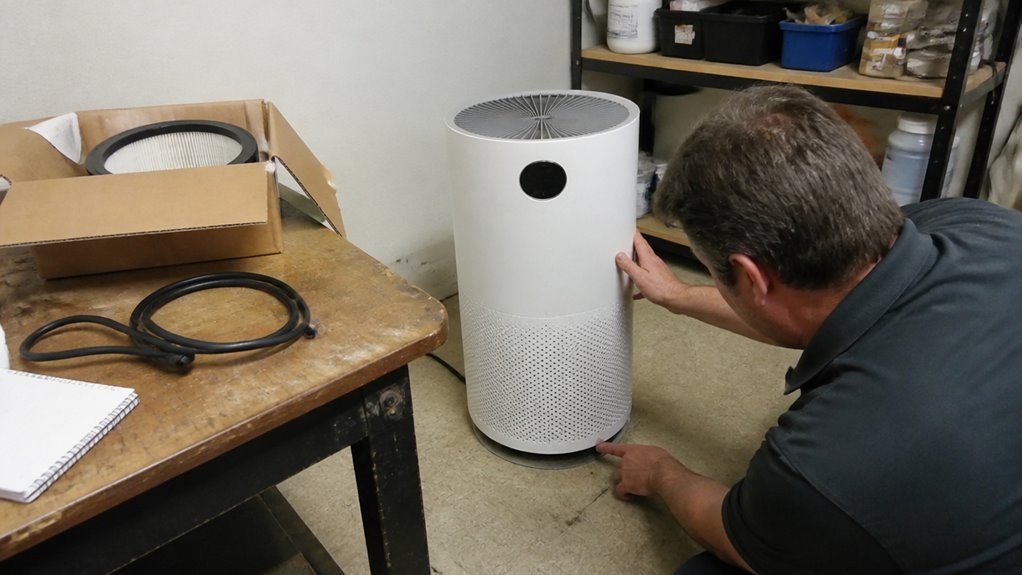
“True HEPA” is a marketing badge, not a legal certification or government approval. The Department of Energy’s standard defines true HEPA as capturing 99.97% of particles at 0.3 microns, the most penetrating particle size, but no one owns the phrase itself.
Any brand can label a filter “True HEPA” even if it barely meets that threshold. Check the efficiency number on the spec sheet rather than trusting the logo.
A genuine HEPA filter purifier typically costs more than a cheap “HEPA-style” model that catches far fewer particles. Trust the specified percentage and verify the fine print before you pay.
HEPA-Type vs. MERV: Spotting Filters That Won’t Pass
Marketing labels often promise more than a filter delivers, and that gap between advertising and certification is where most confusion begins. A product billed as HEPA type or rated MERV 16 may sound impressive, but neither meets the 99.97% efficiency at 0.3 microns that a true HEPA filter requires, since MERV ratings only test performance across a broad 0.3 to 10 micron range and leave submicron capture unverified.
To spot a filter that will not pass the real test, check the box for a specific efficiency number at 0.3 microns rather than relying on buzzwords. Without that figure, you are buying an expensive dust magnet, not a proven air purifier component, and you remain blind to how it handles the fine particles that matter most for indoor air quality.
Marketing vs. Certified
A label that says “HEPA-type” does not guarantee the filtration performance of a true HEPA filter. Certification bodies test real HEPA filters to capture 99.97% of particles at 0.3 microns, while “HEPA-type” has no such standard and may capture only 85% to 99%.
- True HEPA: tested to 99.97% at 0.3 microns, so pass it or skip it.
- HEPA-type: no standard, likely 85% to 99%, so treat it as guesswork.
- Certified: independent lab proof, so ask for the report.
Demand certification rather than trust vague marketing language. A cheaper unit saves money upfront but can miss the mold spores or fine particles you bought it to remove, so spend the extra for a filter with verified performance.
MERV Rating Gaps
MERV 13 filters capture only about half of the 0.3 micron particles that matter most for fine particle removal, while HEPA filters remove 99.97% at that same size. The confusion starts because MERV testing uses larger particles, so a MERV 13 rating does not translate into HEPA level performance for the smallest particles.
Even the top MERV 16 tier reaches just 75% at 0.3 microns, which is better but still far below HEPA grade. True HEPA filters cost roughly $20 to $60 more because they rely on lab verified physics, not marketing claims.
Misleading Label Claims
Misleading labels like “HEPA-type” or “HEPA-like” promise filtration that physics cannot deliver, since they sidestep the true HEPA standard of capturing 99.97% of particles at 0.3 microns. That size is the hardest for any filter to catch, so vague wording turns marketing language into fake credibility without any certified test behind it.
True HEPA filters are tested, certified, and rated for that most penetrating particle size, while a HEPA-type label usually means a basic dust trap with efficiency around 85%. A MERV 13 filter catches larger particles like pollen and pet dander but misses viruses, so don’t assume a higher number means the same protection.
If a box claims “99% HEPA,” that still fails the standard, because real HEPA does not hedge its performance. Check the specification sheet for EN1822 H13 or DOE standard, and if neither appears, you are buying a fan with a filter shaped accessory rather than a certified air cleaner.
Focus your purchase decision on certified numbers from independent tests, not confident adjectives on the packaging. A filter replacement schedule and airflow measurements like clean air delivery rate give you the concrete data to compare units, while noise level and power consumption tell you what daily operation will actually cost.
3 Mechanisms Behind HEPA Filtration: Diffusion, Interception, Impaction
HEPA filtration relies on three physical mechanisms rather than simple sieving. Diffusion captures the smallest submicron particles as they bounce off air molecules and drift into fibers, while interception catches mid size particles that follow airflow lines directly into fiber surfaces.
Impaction handles larger particles that cannot follow the airstream, so they plow straight into fibers and stick. Together these three mechanisms make a HEPA filter work like a maze, not a mesh, which is why it can trap particles across a wide size range.
Diffusion Captures Submicron
HEPA filters actually capture submicron particles more easily than larger ones, because Brownian motion sends them wandering into fibers. Gas molecules constantly bombard particles under 0.3 microns, causing a chaotic jitter that dramatically increases the chance of collision and adhesion.
Lower air velocity strengthens this capture effect by giving particles more time to drift off their streamline. This mechanism dominates below 0.1 microns, which means viruses at 0.02 to 0.3 microns are surprisingly vulnerable to filtration.
Efficiency rises as particle size drops, reversing the usual sieve logic. For an air purifier with a HEPA filter, this behavior ensures that the smallest pollutants are still removed effectively.
Interception Traps Mid-Size
Interception catches mid-size particles, those drifting between 0.3 and 1 micron, as they follow the airflow along streamlines. When a fiber sits too close to their path, the particle’s edge brushes the fiber and sticks, a gentle snag rather than a forceful capture.
Fiber spacing and airflow speed both shape how often this happens. Tighter gaps force more particles into the near-miss zone, while slower currents give particles less momentum to escape, so interception works best when the air moves gently.
- 0.3 microns: Interception wins
- 0.5 microns: Snagged often
- 0.7 microns: Stuck mid-path
- 1.0 microns: Caught, barely
For standard room air, this mechanism quietly handles the tricky middle ground of fine particles. The process relies on geometry and flow, and it operates without drama inside a HEPA filter or similar media.
Impaction Stops Larger Particles
Impaction stops larger particles such as dust mites, pet dander clumps, and pollen grains by forcing them to collide with HEPA fibers. A particle’s momentum overrides the air’s curve, so it crosses the streamline and crashes into a fiber instead of gliding around it.
This mechanism targets particles above 0.3 microns, while diffusion handles the smaller strays. Heavier particles cannot follow sharp air bends, so they hit the fiber head on.
The efficiency of impaction rises with airflow speed, because faster air produces harder collisions. Denser fiber spacing also blocks escape routes, leaving particles fewer ways to slip through.
Picture a crowded hallway where you cannot dodge and simply bump into someone. For HEPA filtration, that collision is exactly what removes pollen and dust from the air.
Why 0.3 Microns Is the Hardest Size for HEPA Filters
The 0.3 micron mark is the hardest size for a HEPA filter to catch, not because these particles are the most dangerous, but because they sit at a physical sweet spot where they dodge the usual capture mechanisms. At this size, particles are too large to be knocked around by air molecules, yet small enough to slip between fibers instead of being intercepted, making them the filter’s weakest link.
Filter engineers counter this with charged nanofibers that grab particles electrostatically, and ionic augmentation that strengthens that pull. Even with these tricks, 0.3 microns remains the benchmark for testing, since everything larger or smaller gets caught more easily, making it the honest measure of filtration performance in a HEPA filter.
How HEPA Filters Are Tested (0.3 µM Claim Is a Myth)
The 99.97% at 0.3 microns figure printed on HEPA filter packaging is an aggregate score, not a single point measurement. The official test protocol, Mil Std 282, uses a DOP aerosol containing a range of particle sizes and averages the results across that range.
The efficiency curve does dip near 0.3 microns, but the claimed number reflects overall performance across the tested particle sizes. The test generates a polydisperse aerosol rather than a perfect 0.3 micron beam, and a photometer measures light scatter, which skews toward larger particles.
The final rating is an aggregate result, not a worst case check. For practical use, this means the filter still captures fine particles effectively, though the exact efficiency at any single size will vary from the printed figure.
What True HEPA Catches: Bacteria, Viruses, and Common Allergens
A True HEPA filter removes 99.97% of particles at the worst case size of 0.3 microns, so it captures nearly all of the material that triggers allergies. Pollen, dust mite debris, and mold spores are all well above that threshold, making allergen removal straightforward.
Viruses are mostly trapped even though they are smaller. They travel attached to larger respiratory droplets, so the filter snags them during normal airflow.
Bacteria range from 0.2 to 2 microns, and they are blocked by impaction and sieving as air passes through the media. This makes bacterial capture nearly complete for common indoor types.
- Pollen: 10 to 100 microns, caught easily
- Mold spores: 3 to 30 microns, caught
- Bacteria: 0.2 to 2 microns, nearly all caught
- Free viruses: 0.02 to 0.3 microns, mostly caught via droplets
The filter targets the particles that cause most allergic reactions, so it directly addresses common indoor allergy triggers. For allergy sufferers, this level of removal reduces the airborne load of the substances that matter most.
Frequently Asked Questions
How Often Should I Replace a True HEPA Filter?
True HEPA filter replacement depends on your air quality and how often the purifier runs. In normal home use, plan to change it every 12 to 18 months, but heavy smoke, dust, or pet dander will shorten that span.
Check the filter monthly if you live with high pollution or run the unit all day. Watch for a visible drop in airflow or a dirty prefilter, as these warn you that the HEPA is clogging. A pressure drop check every three months tells you when to replace it, so you keep capturing dust, pollen, and smoke particles at peak efficiency.
Can True HEPA Filters Remove Smoke and Odors?
The efficiency varies with the filter type. True HEPA filters physically capture smoke particles, but they cannot remove odors because gaseous molecules pass through the mechanical filtration. Odor removal requires an additional activated carbon layer to adsorb volatile compounds effectively.
For smoke and odor control, look for a purifier that combines a HEPA filter with a substantial carbon media stage. Activated carbon works by trapping gas molecules in its porous structure, which is the only way to address the smell. Run the unit on a higher fan speed to increase airflow through both media.
Do HEPA Filters Kill Viruses or Just Capture Them?
HEPA filters capture viruses, not kill them. Virus inactivation requires separate methods like UV light or heat.
Captured pathogens may persist on the filter surface ecology, potentially surviving until removed or degraded. Filter replacement and proper disposal are your main actions for handling trapped viruses. Place the purifier where airflow is unobstructed to maximize capture efficiency.
Are All True HEPA Filters Equally Efficient in Real Rooms?
No, equal theoretical efficiency does not guarantee equal real room performance. Bypass leakage around the filter frame or settling from improper sealing can sharply cut effectiveness.
Identical HEPA filters can perform differently once installed, because air takes the path of least resistance.
Check the filter’s seal and fit in your unit, and press it firmly into place per the manual.
A loose frame lets unfiltered air slip past, so even a top grade filter underperforms in practice.
If you notice dust returning quickly, reseat the filter and inspect the gasket for damage.
What Airflow Rate Keeps HEPA Performance at Its Best?
HEPA performance peaks when filtration velocity stays low, because slower airflow reduces the pressure drop that forces particles through the filter. At 0.3 microns, efficiency drops below 99.97% once velocity exceeds 1.27 cm/s, so keeping speed near 0.5 cm/s protects the rated capture rate.
Operate your purifier on a lower fan setting in a room sized for that airflow, since higher velocities push particles past the fibers. Balance capture and resistance by selecting a fan speed that matches your room volume, not the highest setting available.
For best results, run the unit continuously on that lower speed, and check the filter indicator for clogging, which raises pressure drop over time. Replace the HEPA filter when the indicator lights up to keep velocity inside the safe range.
Rounding Up
Check the spec sheet for 0.3 micron filtration at 99.97% efficiency before you buy. That is the only way to verify a true HEPA filter.
The advice changes if your room is very large or if the filter is heavily used, since airflow and filter condition affect performance. For any questions about cleaning, replacing the filter, or electrical safety, follow the manufacturer’s instructions. If you have respiratory symptoms, talk to a qualified medical professional instead of relying on the filter alone. Make your choice based on your room size and keep the filter maintained.