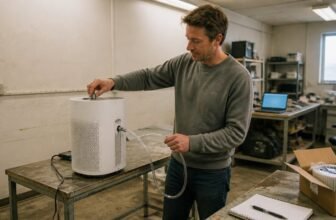
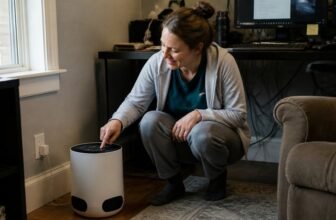
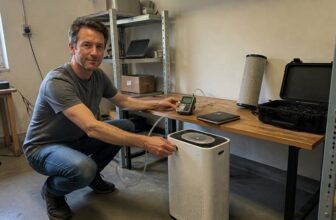
A HEPA filter’s 99.97% efficiency rating means little if air slips around its frame, and that bypass directly undermines the clean air you are trying to achieve.
The honest answer depends on your gasket condition, since even a small gap can silently compromise performance.
This article explains why gasket integrity is the true measure of an air purifier’s effectiveness and how to verify it.
You will learn why seals should be treated as single use and how to check pressure drops regularly.
For best results, choose an air purifier that matches your room size and the specific pollutants you want to address.
Air Purify Highlights
- A 1% gasket leak drops a 99.97% HEPA filter to 98.97% efficiency, and you cannot feel the difference by hand.
- Check your seals with a smoke pencil and pressure gauges, because visual inspection alone will miss tiny bypass gaps.
- Treat every gasket as single use, and re tighten the clips after 24 hours to stop vibration from opening fresh leaks.
- Replace a gasket when the pressure drop goes past 15%, since compression set flattens it and creates permanent air gaps.
- A pinhole of 4.8 mm ruins HEPA performance, while a 3.2 mm hole stays on the safe side of the standard.
Filter Bypass: How It Silently Cuts Your Air Purifier’s Efficiency

Filter bypass lets air sneak around the filter media instead of through it, so a HEPA filter rated at 99.97% efficiency can actually perform closer to 98.97%. You can’t feel a one percent leak with your hand, so detection requires airflow testing around the frame or leak testing with a particle counter.
Skipping gasket checks is the quickest way to ruin media efficiency, since a poor seal creates a direct path for unfiltered air. A $50 gasket protects a $500 filter’s reputation, so inspect seals regularly as part of routine maintenance.
Why Gaskets Fail First: The Compression Set Problem
Gaskets are the silent workhorses of air purification, and they die from a slow, invisible squish. That squish is compression set, the permanent flattening of foam or neoprene after months of being squeezed tight.
Gaskets are the silent workhorses of air purification, dying from a slow, invisible squish called compression set.
Once set, the gasket loses its springy memory, so gaps sneak open every time the housing flexes or vibrates. A fresh gasket, with new compression, seals like a drum.
As the gasket lifecycle drags on, the material creeps, hardens, and starts acting more like a rigid shim than a cushion. Reusing a gasket across multiple filter changes is false economy, since it is already half dead.
The fix is to always match a fresh gasket to each new filter, and skip the gamble of assuming it might still work. Treat gaskets as disposable, one cycle parts.
Cheap insurance beats a leaky bypass, so pair a new gasket with every filter replacement. This keeps the seal intact and prevents unfiltered air from creeping around the filter edge.
Bypass Reality Check: A 3.2mm Hole Keeps HEPA at 99.98%-But a 4.8mm One Doesn’t
The 3.2 millimeter threshold separates a hiccup from a failure. In lab testing, a clean HEPA filter with pinhole damage up to 3.2 mm still captures at 99.98%, but a 4.8 mm hole drops efficiency below the 99.97% HEPA standard, a jump of less than two millimeters that technically ends its HEPA status.
Sealed performance hides these flaws until you measure downstream particles. A small tear from a rough clip or a pinhole in a foam gasket can look harmless, yet airflow finds it and takes the path of least resistance every time.
Inspect gaskets for pinhole damage, or you pay for HEPA and get something less. Keep holes at 3.2 mm or smaller and the filter holds its rating; allow a 4.8 mm hole and the filter fails the standard.
Filter Bypass Prevention: 5 Steps to Verify an Airtight Seal
Inspect the gasket visually at every filter change before checking the media itself. Treat foam gaskets as a single use item and look for cracks or missing chunks.
Run differential pressure monitoring across the filter bank to detect bypass. A sudden drop in pressure indicates air is flowing around the filter instead of through it.
Check the retaining clips for uniform compression rather than just snugness. Uneven gaps between clips suggest the seal is not held evenly against the frame.
Test the seal edges with a smoke pencil while the unit operates. Any drift of the smoke stream toward the filter edge reveals a leak path.
Re tighten the clips after 24 hours of operation because foam gaskets settle under compression. This final step ensures the seal remains airtight after initial seating.
- Visual gasket scan: cracks or chunks missing
- Pressure delta check: drop greater than 15 percent of nominal
- Clip pressure test: uneven gaps between clips
Verify the seal with these steps instead of assuming the filter rating protects the room. A tight seal prevents contaminated air from bypassing the media entirely.
Frequently Asked Questions
How Often Should Gaskets Be Replaced on Unused Spare Filters?
Gaskets on unused spare filters should be replaced every two years owing to shelf life degradation. Storage orientation matters, so stand filters on their edge to prevent compression set.
This preserves the seal’s elasticity until installation. When stored flat, the gasket can flatten permanently, which reduces its ability to block unfiltered air from bypassing the filter media. Proper edge storage protects bypass prevention and keeps the spare ready for use.
Can I Test for Bypass Without Specialized Airflow Measurement Tools?
Can I Test for Bypass Without Specialized Airflow Measurement Tools?
Yes, you can test for bypass without specialized tools. Hold a lit incense stick near the seams and edges of the filter housing and watch the smoke. If the smoke gets sucked toward a gap or wavers, that is a clear sign of air leaking past the filter.
A simple tape test also works; place short strips of masking tape along the filter edges and watch for fluttering. Both methods give you practical, qualitative detection without requiring any airflow meters. They reveal where suction is strong and where a seal is weak.
Does Filter Frame Material Affect Gasket Compression and Sealing?
Frame hardness influences gasket compression, so stiffer frames distribute force evenly across the filter perimeter. Softer frames allow uneven contact, which can lead to seal creep over time as the material flexes.
Frame rigidity is essential for consistent sealing across the entire filter edge. If the housing flexes, the gasket may lose contact in spots, allowing unfiltered air to bypass the media. Choose a filter with a rigid outer frame to maintain stable compression. For best results, follow the manufacturer’s instructions on filter seating and frame compatibility.
What Is the Acceptable Bypass Fraction for a Residential Purifier?
No universal acceptable bypass fraction exists for residential purifiers. Standards instead prioritize zero leak detection.
Ironically, a tiny leak through a media pleat gap can undermine particle counting far more than a visible seal defect.
For accurate filtration, absolute seal integrity matters more than any measured bypass threshold.
Inspect the filter gasket and frame seating whenever you replace the cartridge.
A purifier with a warped or poorly fitted filter will allow unfiltered air to slip past, which defeats its purpose.
How Does Humidity or Temperature Influence Gasket Compression Set Rate?
Humidity cycling accelerates hydrolysis in foam gaskets, which hastens compression set. Temperature creep induces gradual polymer flow, permanently reducing thickness.
Both factors degrade seal integrity faster, increasing bypass potential and diminishing filtration efficiency over time. Monitor your environment’s humidity and temperature swings to predict gasket lifespan. Keep the gasket dry and at stable temperatures to slow this degradation. Seal integrity loss is the main culprit behind reduced filtration performance.
Rounding Up
Check the filter gasket with a flashlight and your hand before every filter change. Replace the foam seal if you find any gap larger than a few millimeters or any visible wear.
The advice changes if your unit is near a drafty window or door, since outside airflow can mask small leaks. If the filter is heavily loaded or the unit is older than five years, inspect the seal twice as often.
Follow the manufacturer’s instructions for gasket replacement and cleaning. For any breathing concerns, consult a qualified medical professional. End by resealing the filter door firmly, then run the unit on high for ten minutes and recheck for drafts.