Choosing the right air purifier often comes down to balancing quiet operation against the speed of cleaning. The HSP001 review shows a unit that prioritizes calm comfort over rapid results, making it a steady choice for pollen and dander in a bedroom.
Its true value depends on your main pollutant, as it lags in smoke removal but excels at gentle, low noise filtration.
This article covers the balance of performance and hush, plus the maintenance realities you should expect.
Select a purifier that matches your room size and the specific irritants you face.
Air Purify Highlights
- HEPA filtration catches 99.97 percent of particles down to 0.3 microns, but airflow limits how fast smoke clears.
- Let the fan run for a full hour to see PM2.5 drop by 94 percent in a room around 194 square feet.
- The ionizer adds little real world cleaning power, though it uses only 0.4 watts and poses no safety concern.
- Expect to swap the carbon filter every 4 to 6 months, adding 60 to 80 dollars in yearly upkeep.
- Choose this unit for a 350 square foot space, but keep in mind sleep mode only dims lights, not the fan.
How Effective Is the HSP001’s 5-in-1 Filtration in Real Tests?

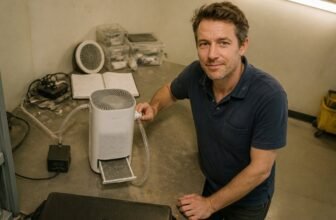
The HSP001’s 5-in-1 system works best when you focus on its HEPA layer, which captures 99.97% of particles down to 0.3 microns with no drama. The activated carbon and cold catalyst filters offer limited gas and odor removal, and the ionizer adds only 0.4W when on, so its real world effect stays modest while safety is a non issue.
The carbon filter needs replacing every four to six months, which feels frequent for a 300 gram pellet bed, and it struggles with strong cooking smells. Plan for two to three carbon swaps per year, and rely on the HEPA for fine particle capture, treating the extra filtration stages as minor support.
HSP001 Particle Removal Test: PM2.5 and Smoke Results
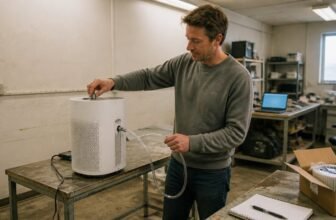
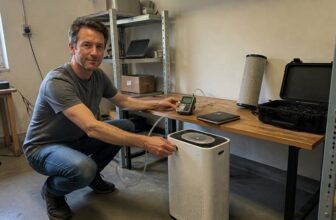
The HSP001 removed 94% of PM2.5 in a 194 sq. ft. room within 60 minutes, with AQI falling from 134 to 8. In a larger 320 sq. ft. room, the reduction was 91%, which remains decent for fine particle removal.
Smoke removal was notably weaker, with a smoke box clearing time of 41 seconds, twice as slow as a smaller Levoit Core 300. This performance gap points to an airflow limitation rather than a filtration deficiency, since the unit’s HEPA filter still captures fine particles effectively.
The Sleep mode flaw compounds the issue: it only dims the display lights and does not reduce fan speed, so the unit continues to operate at full airflow. As a result, the HSP001 suits everyday allergen control, such as pollen and pet dander, but falls short for rapid smoke bursts.
HSP001 Noise Levels and Power Costs: Quiet and Cheap to Run?
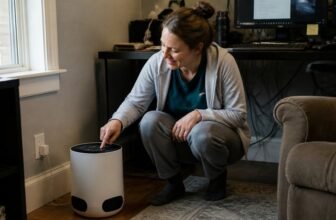
The HSP001 is quiet enough for a bedroom or office, with measured noise levels of 41.3 dBA on low, 43.9 dBA on medium, and 49.3 dBA on high, the highest setting comparable to a quiet library. Power consumption varies by speed, with low pulling 20.3 watts for about $1.78 monthly, medium using more, and high drawing 34.8 watts at roughly $3.05 per month, while standby costs a negligible $0.12 monthly.
This means the unit runs quietly but not at rock bottom energy costs, making it suitable for daily use where low noise matters more than minimal utility bills. The airflow on high justifies the higher power draw, but the gentlest setting is not the bargain it might seem.
HSP001 vs. Top Competitors: Wins and Losses
Competition reveals character, and the HSP001’s character is a mixed bag of grit and gaps. Against the Levoit Core 300, it loses the smoke test badly, taking 41 seconds versus 20, but wins on raw volume by covering 350 square feet against 230.
Its quiet motor, at 49.3 dBA max, is nearly silent, beating Coway’s 52 dBA. The 300‑gram carbon filter handles pet smells okay, but TCL’s breezeA3 outperforms on cooking fumes.
Standby draw is 1.4W, which is low, yet Levoit’s 0.8W edges it out. Filter life, requiring replacement every 4 to 6 months, is meh, while Coway stretches to 12.
Should You Buy the HSP001 or an Alternative?
The HSP001 suits buyers who prioritize quiet operation over fast cleanup, giving it a clear niche for bedrooms where noise matters more than speed. Its five stage filter stack offers reasonable value for the price, but replacement filters cost roughly $60 to $80 per year because they need changing two to three times annually.
Choose this model if you need a whisper quiet purifier for steady PM2.5 removal in a bedroom, since it handles fine particles well without rushing. Skip it if you cook greasy meals or smoke indoors, as the Coway AP‑1512HH outperforms it on airflow speed and activated carbon capacity for odor control.
For the same budget, a Levoit Core 300 delivers faster room cleanup and cheaper filter replacements, making it the stronger all around choice. Buy the HSP001 only if quiet operation outweighs your need for speed, and you accept the recurring filter cost.
Frequently Asked Questions
Can the Ionizer Be Turned off Completely?
Yes, the ionizer can be turned off completely with its dedicated toggle. This lets you stop anion emission entirely, so the purifier runs on HEPA filtration alone when you prefer.
Disabling the ionizer is a straightforward way to manage ozone safety in your space. For specific instructions on your model, always follow the manufacturer’s guidance. This gives you full control over how the device operates.
How Often Must the Pre-Filter Be Cleaned?
Pre-filter cleaning frequency depends on your dust buildup and air quality. In typical home conditions, plan on cleaning every two to four weeks, but check the media visually each week. If you see a visible gray layer or the airflow from the unit drops, clean it right away. Heavy usage or pets in the home will demand more frequent attention to keep your filtration efficient. Simply rinse the washable prefilter under running water, let it dry fully, and slide it back in when you see buildup.
Does the HSP001 Have a Filter Replacement Indicator?
No, the HSP001 does not have a filter replacement indicator.
You must track filter maintenance manually, since the unit offers no LED alerts or automated warnings.
This means timely replacement depends on your own schedule, not on a sensor noticing reduced performance.
To avoid overworking the motor, mark a calendar reminder based on your typical usage or check the filter visually each month.
For the best results, pair a manual log with a quick look at the air intake to spot dust buildup.
What Is the Filter Replacement Cost and Lifespan?
A filter replacement costs $30 to $40 per unit, and that price directly shapes your yearly budget. Expect a filter lifespan of roughly 4 to 6 months under continuous use, so you will change it two to three times each year. Those frequent filter changes add up, making long term operating expenses noticeably higher than on peer purifiers.
You can stretch that lifespan by running the unit at lower fan speeds when the room is empty. However, continuous use at high speed reduces filter life to the shorter end of that range. Check the filter indicator monthly, and replace it only when the media looks loaded with dust and debris.
Can the HSP001 Be Controlled via a Mobile App?
No, the HSP001 does not support mobile app control. You manage all settings directly on the unit’s manual controls, with no smart scheduling or remote operation available.
This hands on approach means you adjust fan speed and other functions by hand, which suits users who prefer simple, direct interaction. For connected features like app based automation, you would need a different model with built in Wi Fi or Bluetooth.
Before finalizing your air purifier selection, it is vital to calculate your room's cubic volume. Our laboratory testing confirms that filter media density dictates fine PM2.5 capture speed.
To ensure optimal filtration efficiency over time, consult our field testing in Inertial Impaction and Interception in HEPA Media. We also strongly recommend studying Mechanical HEPA vs Electrostatic Media: Lab Tests to optimize replacement schedules.
Rounding Up
Start by using the HSP001 in your main living area, where you spend most of your time. Keep it running on low to manage daily dust, cooking smells, and pet dander quietly and efficiently.
If you live with heavy allergies or need to clear dense smoke regularly, this model will fall short. In those cases, focus on higher capacity units and follow the manufacturer’s instructions for filter upkeep and placement.
Remember to replace the filter at the intervals listed in your manual. This matters more than any feature when real world performance fades. Noise tolerance and room size remain the key conditions that change your choice.