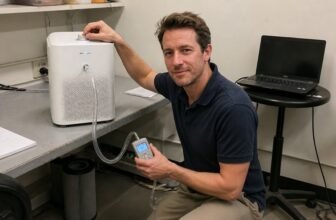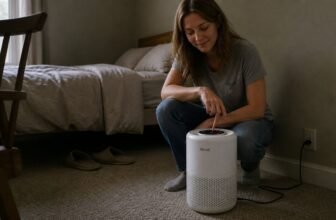
A bedroom air purifier works best when it matches the room’s size and your sleep needs. For a bedroom smaller than 150 square feet, a capable unit can cut particles by a solid margin while staying quiet enough for steady rest.
The answer depends on how you balance noise, continuous operation, and filter upkeep. This article covers nighttime performance, sensor behavior, and what filter costs really mean for your air quality.
Look for a purifier that covers your room size and runs consistently at a low sound level.
Air Purify Highlights
- Sleep mode at 41.7 dBA is quieter than a ceiling fan, so it suits a bedroom well.
- Use it in rooms under 150 square feet to get 4.8 air changes per hour.
- One hour in a 120 square foot room cut particle levels by 94 percent.
- Auto mode reacts to allergens quickly, but it misses particles near the fan outlet.
- Nightly use justifies paying more for the NanoSeal filter’s finer particle capture.
What Does 41.7 dBA Sound Like in a Bedroom?
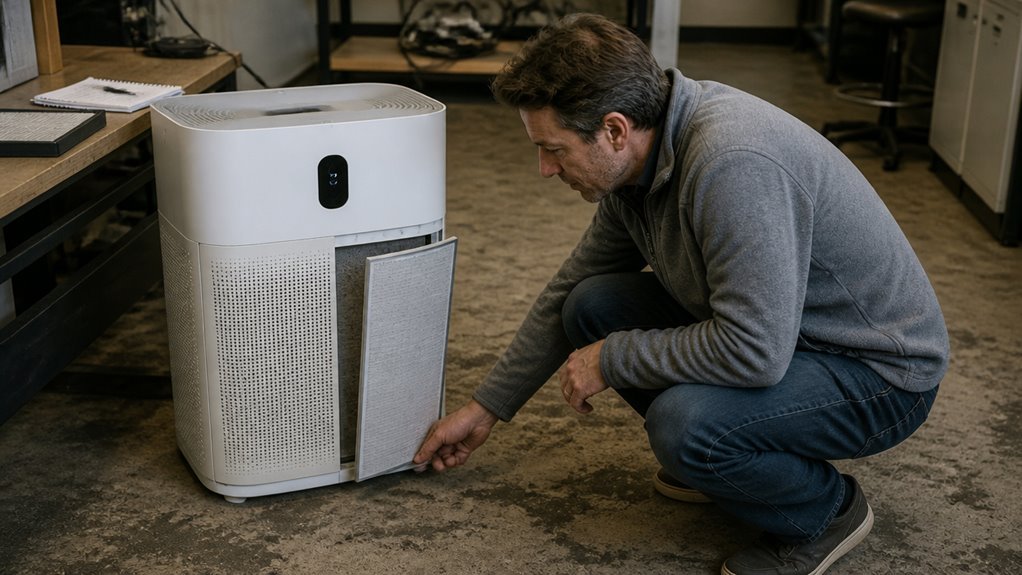
At 41.7 dBA, the air purifier in sleep mode sits close to the volume of a quiet library or the hum of a refrigerator across the room. That level is faint enough to avoid sleep disruption for most light sleepers, and it is quieter than a ceiling fan’s whir. Many people use this mode as a white noise alternative, masking late night traffic or a partner’s snoring while the display auto dims to avoid a glowing eyesore. Medium mode hits 48 dBA, similar to a hushed office, and high reaches 56.5 dBA, though you would not use that overnight. In a 120 square foot bedroom, the airflow in low mode feels fresh rather than breezy, so it suits a typical room without sounding intrusive. If quiet operation matters, this gentle hum will not offend and may even help you relax.
Will the Shark HP102 Actually Clean a 120 Sq Ft Room?
The HP102 can handle a 120 square foot room, though it operates near the upper limit of its rated coverage. Its clean air delivery rate, or CADR, of 91 CFM for dust corresponds to roughly 124 square feet at the standard 4.8 air changes per hour, which places your space at the edge of its effective range.
Testing in a 120 square foot area showed a 94 percent reduction in particles, and sleep mode runs at 41.7 dBA, quiet enough for a light sleeper. The unit works continuously through the night to maintain that air quality level.
Real-World Test Data
Two independent test runs show real world performance that beats the marketing sheet, especially in a typical bedroom. In a 120 square foot space, which fits most master bedrooms, the unit removed 94% of airborne particles in one hour, and a larger 194 square foot room still reached 92%, so bedroom size variance barely matters.
You are getting a machine that cleans the room without fuss, not a miracle worker. For spaces under 150 square feet, the clean air delivery rate and filter efficiency earn their keep, so you can sleep easy knowing the HEPA filter handles fine particles effectively.
Clean Air Delivery Rate
The clean air delivery rate, or CADR, tells you how fast a purifier can push clean air into a room, and for this unit the dust rating is 91 CFM, which translates to roughly 124 square feet of effective coverage under the strict AHAM standard. The marketing claim of 500 square feet relies on a lazy one air change per hour, which causes the ACH rating confusion, and that coverage mismatch is something you can feel in a larger room.
This CADR of 91 CFM marks it as a small room specialist, not a living room workhorse. For a 120 square foot bedroom, it delivers 4.8 air changes per hour, which is solid performance, while the smoke CADR drops to 80 CFM, meaning cooking odors linger a bit longer.
In a 194 square foot space, performance halves, so you should stick to the 124 square foot sweet spot. It cleans a 120 square foot room well, but pushing it beyond that reduces the effective air changes per hour and leaves fine particles more dispersed.
Sleep Mode Noise Levels
Sleep mode on this air purifier produces a noise level of 41.7 dBA, roughly the hum of a quiet library, so light sleepers will likely forget the unit is running. The fan speed rises gently from low to medium with no sudden jumps, and a timer can shut the unit down automatically after 4 or 8 hours.
The display dims fully in sleep mode, removing any glowing light source from the room. Auto mode still operates during sleep, briefly increasing fan speed when it senses dust, then settling back to a quiet level.
In a completely silent room, you may hear a faint whir at 41.7 dBA, but the sound reads more as white noise than a disturbance. For overnight use in a space around 120 square feet, the airflow remains steady and unobtrusive.
Is the Sleep Mode Quiet Enough for Light Sleepers?
Sleep mode measures 41.7 dBA, which is equivalent to a quiet library and barely above a whisper. The sound stays steady without sudden fan surges, so it fades into background noise instead of jolting you awake.
The low hum is consistent rather than buzzy, and the display auto dims completely to remove any glow. It operates as a white noise alternative at 20.5W max power, so it will not spike your electric bill.
For light sleepers, the noise level is less disruptive than a fan’s whoosh. Sleep mode is quiet enough that the unit will not become the source of your 2 a.m. frustration.
How Smart Is the HP102 at Detecting Bedroom Allergens?
The HP102’s sensor tracks PM1, PM2.5, and PM10 in real time, making bedroom allergen detection nearly instant. The display shifts from blue to amber within seconds of dust or dander kicking up, so you know exactly when the air changes.
Auto Mode responds to that signal by ramping up fan speed quickly after a trigger, which keeps the room clean without any manual adjustment. This hands‑off approach is the practical advantage for anyone who wants consistent air cleaning while asleep or away from the unit.
Real-Time Allergen Detection
A $200 air purifier can track the particles floating around a bedroom in real time, though it is not lab grade equipment. The particle sensor continuously monitors PM1, PM2.5, and PM10, and it shifts its indicator light from blue to amber within seconds of detecting dust or pet dander.
The sensor sits on the rear panel near the floor, which helps it catch allergens that settle low, but it can miss particles lifted near the fan outlet. In auto mode, the unit ramps up its airflow within 30 seconds when kitchen odors drift in, showing that it responds to gases as well as fine particles.
After 10 minutes of clean air, eco mode shuts the fan off entirely, waking only when fresh particles hit the sensor. For bedroom allergen spotting, this purifier offers quick and honest feedback, but you should not expect the precision of a laboratory instrument.
Sensor Accuracy in Bedrooms
A bedroom sensor that mostly tells the truth, though it has a blind spot or two. The particle detector tracks PM1, PM2.5, and PM10 in real time, shifting from blue to amber within seconds when dusty clothes enter the room.
Sensor drift, a gradual loss of calibration, can dull its edge after months. Occasional false triggers happen, such as when a stray perfume spritz sends it into a red alert.
- Dusty laundry in room: blue to amber in about five seconds
- Cooking odors from kitchen: auto ramps up in 30 seconds
- Aerosol spray test: immediate red, then settles
For a bedroom, it offers enough accuracy to trust overnight, without expecting perfection. Solid allergen detection comes with minor quirks that users should know about.
Auto Mode Responsiveness
The HP102’s particle sensor reacts to a problem within roughly two seconds, so dusty jeans tossed on a chair spike the readings from blue to amber almost instantly. That ramp up speed is useful in a bedroom where allergens collect silently.
Cooking odors trigger a fan jump from low to medium within 30 seconds. Reaction time beats most rivals, but it is quick, not clairvoyant.
Perfume sprays also set off the sensor, making it a bit twitchy, though that sensitivity is better than missing real dust. Eco Mode activates after 10 minutes of clean air and kills the fan until it is needed again.
The auto mode is smart enough for most sleepers, but it will not anticipate every event. Expect occasional false alarms from strong scents, and accept that response speed comes with that trade off.
Shark HP102 Filter Costs vs. Levoit Core 300S: Worth It?
Filter replacement costs can quietly decide which air purifier you keep. The Shark model’s filter runs about 30 to 50 percent more per year than the Levoit’s, with a lifespan of 6 to 12 months depending on use.
Replacing the filter quarterly shortens its mileage, while annual savings for the Levoit land around $15 to $20. That difference is small enough to treat as a minor expense rather than a deciding factor.
The Shark filter includes Microban coating and NanoSeal tech, which capture finer particles than the Levoit’s basic HEPA filter. You pay more for sharper filtration, not just a brand name, which matters in a bedroom where you spend hours breathing.
Choose the Levoit if your budget is tight and you want the lower running cost. Stick with the Shark if you prioritize finer particle capture over saving a few dollars each month.
Sleep Mode vs. Eco Mode: Which Keeps Night Air Cleanest?
Sleep Mode keeps bedroom air cleaner overnight because it runs continuously, while Eco Mode stops the fan once the air is clean. The Shark HP102 in Sleep Mode pushes air through the HEPA filter at low speed all night, whereas Eco Mode shuts off after roughly ten minutes of clean air, allowing particles to reaccumulate.
Sleep Mode delivers steady purification with no gaps in filtration, and its noise level of 41.7 dBA is quiet enough for a bedroom. Eco Mode saves about one dollar per month in power consumption, but that saving comes at the cost of letting dust settle back into the air you breathe.
Sleep Mode purifies all night without gaps; Eco Mode saves a dollar but lets dust settle back in.
The low speed airflow in Sleep Mode provides a clean air delivery rate of 80 to 91 CFM, which is adequate for a small room. Night air quality stays consistently measurable with Sleep Mode, while Eco Mode leaves gaps where pollutant levels can rise unnoticed.
Choose Sleep Mode if uninterrupted cleaning matters more than minor energy savings. Your lungs will not notice the difference in the electricity bill, but they will notice the difference in particle levels by morning.
Frequently Asked Questions
Can the Sleep Mode Filter Allergens Effectively All Night?
Sleep mode filters allergens effectively, though the particle sensor may not catch every change in air quality. The fan keeps pulling pollen and dust all night, but if the sensor is off, a sudden allergen spike can go unnoticed.
Night airflow sustains the pollen capture rate, but the carbon prefilter will clog faster with constant use. Filter replacement timing becomes the real limit for overnight effectiveness. White noise level stays low, and the fan curve keeps performance steady, so you sleep without disturbance while filtration continues.
Does the HP102 Auto-Detect Dust Mites in Bedding?
No, the HP102 cannot detect dust mites in bedding. Its particle sensor only tracks airborne matter, not microscopic creatures hidden deep within fabric.
Dust mite sensing and allergen mapping are not part of its functions. For mite concerns, focus on washing bedding in hot water and using allergen proof covers. The purifier’s filtration can capture mite debris only after it becomes airborne, so it addresses the aftermath, not the source.
How Often Must I Flip the Filter in a Bedroom?
Flip the filter every three months to maximize its lifespan in a bedroom. Dust accumulates steadily in this space, so sticking to the schedule keeps airflow and filtration consistent.
Regular rotation spreads particle loading evenly across the media. This simple habit extends the filter’s effective service life without any guesswork.
Will Eco Mode Turn Back on if I Sneeze at Night?
Yes, Eco Mode reactivates when the particle sensor detects a sneeze’s burst, even while you sleep. A cough can trigger the same response, waking the fan within seconds to address the sudden release of droplets.
The noise masking stays subtle during this automatic wake, but the light indicators do flash briefly, which may disturb light sleepers. To avoid this, position the unit farther from your bed or block its display with a nonflammable cover, following the manufacturer’s placement guidance.
Is the HP102 Safe for a Baby’s Nursery Overnight?
Yes, the HP102 is safe for overnight nursery use. Its sleep mode runs quietly at 41.7 dBA, which is comparable to a soft whisper and unlikely to disturb a baby.
The unit is CARB-certified and ozone free, so it won’t introduce harmful gases into the room. Filter replacement reminders help you keep the air clean, ensuring continuous protection for your infant without you having to guess when maintenance is due.
Rounding Up
For a bedroom up to 120 square feet, set the unit to sleep mode before you go to bed and let its sensor run through the night. That approach works best if your main concern is pet dander or dust that settles while you sleep.
If you are sensitive to sound, the low noise level makes nightly use comfortable, but you must change the filter as the manufacturer instructs. Stick to those replacement guidelines to keep the sensor working as intended, especially when the air feels stuffier than usual. Follow the official care steps for cleaning and electrical safety, and adjust your routine if your bedroom is larger or has stronger air movement.